


Beyond the Egg
Mastering the Art of Shipping Hatching Eggs
The Complete System for Shipping Eggs Safely and Professionally
Online Courses
-
Beyond the Egg
Designed for elevating your hobby to a business. From NPIP to boxing to email marketing, what you want to know to move efficiently into the business of shipping hatching eggs and live birds.
-

Incubation Masterclass: Quail
Designed to walk with you on the quail incubation journey. From incubator set up to embryology, the entire process is explained to elevate your success in a sustainable method to maximize your investment in the incubator and eggs.
-

Incubation Masterclass: Chickens
Designed to support your incubating methods with knowledge to increase hatch rates and chick vigor. From nutrition to troubleshooting, you will leave with information that will only improve your skills with each hatch.
Handling-Related Stressors Affecting Hatchability of Quail Eggs: A Bibliographic Review and Practical Application from Breeder to End User
Jennifer Bryant
Bryant’s Roost
Published February 20, 2026
Abstract
This review examines handling-related stressors affecting hatchability of quail eggs across the breeder-to-end-user continuum. A structured literature review was conducted to evaluate the effects of egg storage, transport vibration, egg orientation, handling during candling, and sanitation practices on embryonic mortality and hatchability outcomes. Primary research indicates that transportation, mechanical disturbance, repeated handling, and egg washing may contribute to reduced hatchability, with mortality frequently occurring during late incubation. Evidence suggests that these factors act cumulatively, even when incubation temperature and humidity are properly maintained. Engineering studies of vibration mitigation provide mechanistic insight into internal egg movement as a contributor to embryonic loss. A practical case study demonstrates application of literature-informed handling and transport practices to improve hatch consistency. Findings support a preventive approach emphasizing transport protection, minimal handling, and stable egg orientation to reduce avoidable embryonic loss in quail production systems.
-
Efficient incubation is fundamental to poultry production systems, as hatchability directly influences
productivity, economic viability, and genetic progress. In quail production, hatchability is particularly
important due to the species’ rapid embryonic development, short generation interval, and increasing use
of quail eggs in both commercial breeding operations and small-scale distribution networks. Despite
improvements in incubator technology and standardized incubation parameters, variability in hatch
outcomes remains a persistent challenge.
Hatch failures are commonly attributed to deviations in incubation temperature, humidity, or turning
frequency. While these factors are critical, primary research indicates that handling-related stressors
occurring before and during incubation may also contribute substantially to embryonic mortality. These
stressors include egg storage duration, transport-related vibration and shock, orientation instability,
repeated handling during candling, and sanitation practices such as egg washing. In practical settings,
eggs are often exposed to multiple stressors sequentially, suggesting that hatch losses may result from
cumulative effects rather than a single failure point.
Quail eggs may be especially susceptible to handling-related stress due to their small size, thin shells, and
reduced thermal inertia compared with chicken eggs. These characteristics can amplify the biological
consequences of mechanical disturbance, temperature fluctuation, and shell surface disruption, with
mortality often concentrated during late incubation.
The objective of this review is to analyze research addressing handling-related stressors that affect
hatchability of quail eggs throughout the incubation process. Findings are summarized in the graph and a
practical application is presented to demonstrate how literature-informed handling and incubation
practices may be applied in daily hatchery operations to reduce embryonic loss and improve hatch
consistency.
-
A structured search was conducted to identify research studies examining factors affecting hatchability of
quail eggs, with emphasis on handling-related stressors before and during incubation. Literature searches
were performed using Web of Science, PubMed, Scopus, and Google Scholar. Search terms included
quail hatchability, egg incubation, egg orientation, egg turning, transport vibration, handling stress,
candling, and egg washing.
Studies were included if they reported original experimental data and evaluated hatchability, embryonic
mortality, or related incubation outcomes in quail or other avian species with relevance to quail incubationphysiology. Review articles were consulted only for background context and were not used as primary
data sources. Data extracted from each study included egg number per treatment, incubation conditions,
description of the handling stressor, hatchability of fertile eggs, and embryonic mortality patterns.
-
Transportation, Mechanical Stress, and Vibration Mitigation
Primary research consistently demonstrates that transportation of hatching eggs reduces hatchability, even
when fertility and incubation parameters are controlled (Table 1). Studies evaluating road transport,
simulated vibration, and transport distance report significant declines in hatchability of fertile eggs
relative to non-transported controls (Tona et al., 2003; Donofre et al., 2017). In quail and other avian
species, hatchability reductions of approximately 10–15 percent have been reported following transport,
with embryonic mortality occurring despite intact eggshells, indicating internal damage rather than
mechanical breakage (Shahbazi and Mohammadzadeh, 2013). Transport-related vibration has also been
associated with displacement of the air cell, a mechanism linked to increased late embryonic mortality
despite intact eggshells (Romanoff, 1960; Berardinelli et al., 2003).
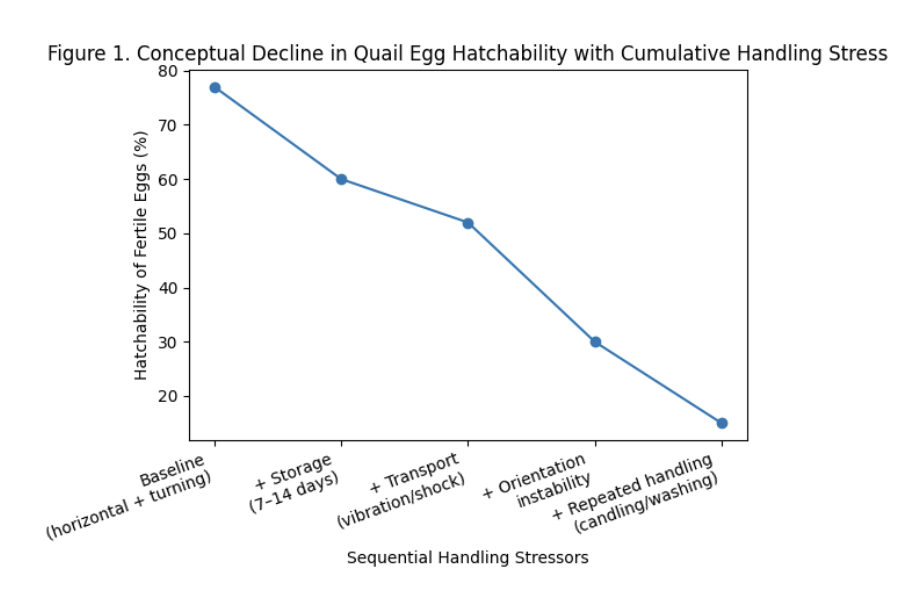
Figure 1. Conceptual decline in hatchability of fertile quail eggs with cumulative handling-related
stressors.
Figure 1 illustrates the directional decline in hatchability as handling-related stressors are sequentially
introduced across the incubation process. Values are derived from ranges reported in independent primary
studies and are presented to demonstrate cumulative risk rather than predictive outcomes.
Experimental and field-based studies indicate that vibration frequency and duration are key determinants
of transport-related hatch loss, with higher or prolonged vibration reducing hatchability and increasing
embryonic mortality compared with stationary controls (Shahbazi and Mohammadzadeh, 2013; Donofre
et al., 2017). Mortality is frequently concentrated during late incubation, consistent with delayed effects
of mechanical disturbance on embryonic development (Tona et al., 2003).
Engineering studies of vibration-sensitive products provide mechanistic insight, demonstrating that
closed-cell polyolefin foams, including expanded polyethylene-type foams, substantially reducetransmitted vibration and peak acceleration by limiting internal movement (Burgess, 1990; Sek et al.,
2000). Foam-based immobilization systems reduced vibration transmissibility by approximately 40–80%,
depending on material properties, whereas loose-fill or non-immobilizing materials allowed continued
internal movement under vibrational loading (Sek et al., 2000; Singh and Burgess, 2001).
Although conducted on electronic and medical devices rather than biological materials, these studies
demonstrate that internal displacement under vibration can occur in the absence of visible external
damage, a finding consistent with observations in transported hatching eggs (Berardinelli et al., 2003;
Tona et al., 2003). The reported effectiveness of foam-based immobilization in reducing vibration
transmission supports the conclusion that transport-related hatch losses are mechanistically linked to
internal egg movement rather than shell damage alone. Collectively, these findings indicate that
transportation represents a significant handling-related stressor affecting hatchability prior to incubation
and contributes to the cumulative decline in hatch success illustrated in Figure 1.
-
Experimental studies demonstrate that quail egg hatchability is highly sensitive to egg orientation, turning
consistency, and handling stability during incubation. Research conducted under controlled conditions
indicates that horizontal egg positioning combined with regular, predictable turning supports proper
embryonic development and reduces late embryonic mortality (Sittmann et al., 1966; Moraes et al., 2008).
However, the specific incubator designs and turning mechanics used in these studies were not described in
detail, limiting direct comparison with modern consumer incubators.
At the end-user level, incubators employ a wide range of turning systems, including rocking, tilting,
rotating, and circular motion. While intended to automate turning, these systems may differ substantially
in the axis, amplitude, and regularity of egg movement. From a biological standpoint, hatchability
depends less on the turning mechanism itself than on the consistency of egg orientation experienced by
the embryo. Irregular rotation or excessive movement may increase the risk of embryonic malposition and
late-stage mortality, even when incubation temperature and humidity are properly maintained (Deeming,
1995; Wilson, 1991).
Handling practices commonly used by consumers may further contribute to embryonic stress. Repeated
candling, prolonged egg removal from the incubator, and manual rotation introduce uncontrolled
movement and transient cooling, particularly in small eggs such as quail, which have low thermal inertia
(Meijerhof, 1992; Narushin, 2005). Similarly, washing of hatching eggs may disrupt the eggshell cuticle
and increase susceptibility to moisture loss or microbial penetration, especially when temperature
differentials are not carefully controlled (Brake and Sheldon, 1990; De Reu et al., 2006). Although each
practice may appear minor when considered individually, repeated exposure may result in cumulative
stress across the incubation period.
Collectively, these findings suggest that for end users, minimizing unnecessary handling, avoiding
washing of hatching eggs, and maintaining stable, predictable egg orientation throughout incubation may
be as important as maintaining correct incubator temperature and humidity. Hatchability outcomes
observed under controlled research conditions may therefore not translate directly to consumer systems
when eggs are subjected to frequent handling, orientation instability, or additional sanitation interventions
applied without strict process control.
-
Primary studies indicate that handling-related practices during incubation contribute to embryonic stress
and reduced hatchability, particularly when exposure is repeated or prolonged. Repeated removal of eggs
from the incubator results in transient temperature fluctuations and increased embryonic mortality
compared with undisturbed controls (Meijerhof, 1992). These effects are amplified in small eggs, such as
quail, due to lower thermal inertia and more rapid heat loss during handling events (Narushin, 2005).
Candling itself has not been shown to impair embryonic development directly, however, the associated
handling, rotation, and duration of egg exposure outside controlled incubation conditions represent the
primary sources of risk (Meijerhof, 1992). Eggs subjected to repeated handling exhibited higher rates of
late embryonic mortality than minimally handled controls.
Studies examining sanitation practices report that washing of hatching eggs reduces hatchability
compared with dry-cleaned or unwashed controls (Brake and Sheldon, 1990; De Reu et al., 2006).
Adverse effects were attributed to disruption of the eggshell cuticle, altered moisture loss, and increased
susceptibility to microbial penetration, identifying handling, candling-associated manipulation, and
washing as contributors to reduced hatchability prior to and during incubation.
-
Findings from this review indicate that handling-related stressors act cumulatively across the incubation
process, contributing to reduced hatchability even when incubator temperature and humidity are properly
maintained. Transport-related vibration, orientation instability, repeated handling during candling, and
washing practices each introduce mechanical or thermal disturbances that may not be lethal individually
but can interact to increase embryonic mortality. The conceptual model presented in Figure 1 illustrates
how sequential exposure to these stressors may result in a progressive decline in hatchability.
A consistent pattern across studies is the predominance of late embryonic mortality, suggesting that
handling-related stressors disrupt processes critical during the final stages of incubation, including
embryo positioning, gas exchange, and transition to pulmonary respiration. Transport studies reporting
reduced hatchability in the absence of shell damage support the conclusion that internal structural
disruption, rather than overt breakage, is a primary mechanism of loss. Orientation studies further
demonstrate that improper positioning or inadequate turning increases late mortality, reinforcing the
sensitivity of embryos to mechanical factors during incubation.
Handling practices such as candling and washing represent additional sources of disturbance that may
exacerbate pre-existing stress introduced during storage or transport. Although these interventions are
often performed to improve monitoring or hygiene, evidence indicates that their associated handling and
thermal effects can outweigh potential benefits when applied repeatedly or without strict process control.
These risks may be amplified in quail eggs due to their small size, thin shells, and reduced thermal inertia.
Collectively, the literature supports a preventive approach to hatchability management in which
minimizing unnecessary handling and maintaining stable egg orientation throughout incubation are
prioritized alongside traditional incubation parameters. Such an approach is particularly relevant in
consumer incubation systems, where variability in equipment design and handling practices may increase
exposure to cumulative embryonic stress.
-
A quail breeder distributing hatching eggs directly to end consumers sought to improve hatch consistency
by addressing losses occurring after shipment rather than during incubation alone. Eggs were transported
to customers using immobilization methods designed to reduce vibration and orientation instability during
transit. Based on findings from the reviewed literature, additional emphasis was placed on educating end
users regarding handling practices upon receipt, including allowing eggs to rest before incubation,
maintaining consistent egg orientation, minimizing candling frequency and duration, and avoiding
washing of hatching eggs. Customers were also guided to appropriate incubation parameters specific to
quail. Following implementation of improved transport practices and distribution of literature-informed
handling recommendations, customers reported more consistent hatch outcomes and reduced late
embryonic mortality. Although observational, this case demonstrates how integrating transport protection
with evidence-based consumer education can improve hatchability across the breeder-to-end-user continuum.
-
Hatchability of quail eggs is influenced not only by incubation temperature and humidity, but also by a
series of handling-related stressors that occur before and during incubation. Evidence from primary
studies indicates that transport vibration, orientation instability, repeated handling during candling, and
washing practices can act cumulatively to increase late embryonic mortality, even in eggs with intact
shells. These findings highlight the importance of a preventive approach that prioritizes minimizing
unnecessary handling and maintaining stable egg orientation throughout the incubation process.
Integrating transport protection with evidence-based guidance for end users offers a practical strategy to
improve hatch consistency and reduce avoidable losses across the breeder-to-end-user continuum.
-
Berardinelli, A., A. C. Donati, M. Giunchi, A. Guarnieri, and L. Ragni. 2003. Effects of transport
vibrations on quality indices of shell eggs. Biosystems Engineering 86:347–353.
Brake, J., and B. W. Sheldon. 1990. Effect of egg washing during storage on hatchability of broiler
hatching eggs. Poultry Science 69:1585–1591.
Burgess, G. 1990. Shock and vibration protection with polymeric foams. Packaging Technology and
Science 3:149–156.
Deeming, D. C. 1995. Factors affecting hatchability during incubation of birds’ eggs. World’
s Poultry
Science Journal51:17–28.
De Reu, K., K. Grijspeerdt, M. Heyndrickx, J. Zoons, K. De Baere, M. Uyttendaele, and L. Herman.
2006. Bacterial eggshell contamination in the egg production chain and the influence of different housing
systems. British Poultry Science47:163–172.Donofre, A. C., A. A. Silva, L. J. C. Lara, R. L. A. Torres, and M. A. M. Vieira. 2017. Vibration levels
during transport of fertile eggs and their effects on hatchability. Revista Brasileira de Ciência Avícola
19:629–636.
Meijerhof, R. 1992. Pre-incubation holding of hatching eggs. World’
s Poultry Science Journal 48:57–68.
Moraes, T. G. V ., J. C. C. Murakami, I. C. L. Piccinin, and M. E. L. A. Furlan. 2008. Effects of egg
position and turning on hatchability of Japanese quail eggs. Revista Brasileira de Zootecnia
37:1706–1711.
Narushin, V . G. 2005. Egg geometry calculation using the measurements of length and breadth. Poultry
Science 84:482–484.
(Note: commonly cited for egg mechanics and deformation in incubation literature)
Sek, M. A., V . Rouillard, and G. Burgess. 2000. Vibration transmissibility of cushioning materials.
Journal of Sound and Vibration 236:513–529.
Shahbazi, F., and H. Mohammadzadeh. 2013. Effects of transport vibration on hatchability of broiler
breeder eggs. Journal of Agricultural Science and Technology 15:1103–1110.
Singh, S. P., and G. Burgess. 2001. Measurement and analysis of cushioning materials for protective
packaging. Packaging Technology and Science 14:253–261.
Sittmann, K., H. Abplanalp, and R. A. Fraser. 1966. Inbreeding depression in Japanese quail. Genetics
54:371–379.
(Note: includes hatchability and embryonic mortality data relevant to egg orientation and viability)
Tona, K., F. Bamelis, B. De Ketelaere, V . Bruggeman, V . M. B. Moreas, J. Buyse, O. Onagbesan, and E.
Decuypere. 2003. Effects of egg storage time on spread of hatch, chick quality, and chick juvenile growth.
Poultry Science 82:736–741.
(Commonly cited in transport and handling stress discussions)
Wilson, H. R. 1991. Interrelationships of egg size, chick size, posthatching growth, and hatchability.
World’
s Poultry Science Journal 47:5–20.