

Bryant’s Roost Supplement Field Study
-
The Bryant’s Roost Supplement Field Study is designed to evaluate the impact of gut health supplementation on growth, vigor, fertility, hatchability, feather quality, overall health, and mortality in Jumbo Coturnix quail and Bresse chickens.
This ongoing study tracks developmental and reproductive outcomes under controlled conditions to determine whether targeted supplementation improves measurable breeder performance and chick viability.
-
Supplement intake will be measured per group and recorded over time. Growth rate, onset of lay, egg production, fertility, and hatchability will be tracked to evaluate the relationship between supplementation and breeder performance outcomes.
-
The supplement used in this trial was provided at no cost by the manufacturer.
To maintain objectivity and prevent external influence during the study period, the specific product is not being publicly identified at this time. The manufacturer has had no input on trial design, data collection, interpretation, or reporting.
All observations and data are recorded independently under standard breeder conditions at Bryant’s Roost.
Full product identification, formulation details, and sourcing information will be disclosed in the final published report upon completion of the study.
Fermex Field Study Update: First Next-Generation Results and Bresse Fertility
New field-study results: 31 WR3 chicks reached three weeks with zero brooder deaths, while the Bresse feed-additive group showed 100% fertility at day 9.
The supplement field study has now reached an important next stage: birds that received it from hatch have matured, begun producing eggs, and moved into their own hatch evaluations.
As with the earlier reports, these are ongoing farm observations—not final conclusions. We will continue documenting the results as each group progresses.
Coturnix: WR3 Chicks Through Three Weeks
WR3 breeders received the supplement from hatch and later entered the hatch trial. Their fertility was within the normal range for the group.
The July 18 hatch produced:
31 live chicks
7 chicks that died in shell
5 unfertilized eggs
The live chicks were notably uniform in size and appeared healthy at hatch. Most importantly, all 31 chicks remained alive through three weeks of age, with zero brooder deaths reported.
That does not establish a cause on its own, but the uniformity and early survival are encouraging observations worth following as the birds continue to grow.
Bresse: First Eggs From the Feed-Additive Group
A separate Bresse group received the supplement mixed into its feed from hatch, rather than being offered it free-choice. These birds are now approximately 28 weeks old and have begun laying full-sized eggs.
Eggs were set from four Bresse breeding groups, including the feed-additive group. Across all groups, the eggs weighed 60–65 grams and were clean and well shaped.
At day 9 of incubation, the feed-additive group was the only group with 100% fertility.
This is an early observation from a single set, so the upcoming hatch will be important. The next update will document hatch rate, chick health, and early survival.
Turkey Poults
The heritage turkey poults previously noted in this study continue to grow well on pasture. The groups that received the supplement from hatch still have zero deaths. They continue to receive it combined into their feed daily.
What Comes Next
The next update will follow the Bresse hatch and early chick performance, including:
Hatch rate
Chick size and uniformity
Chick health and vigor
Early survival
The goal remains the same: to track results beyond egg production and fertility, following breeder nutrition through the egg, hatch, and early life of the offspring.
Fermex Hatch Trial : Preliminary Hatch Results
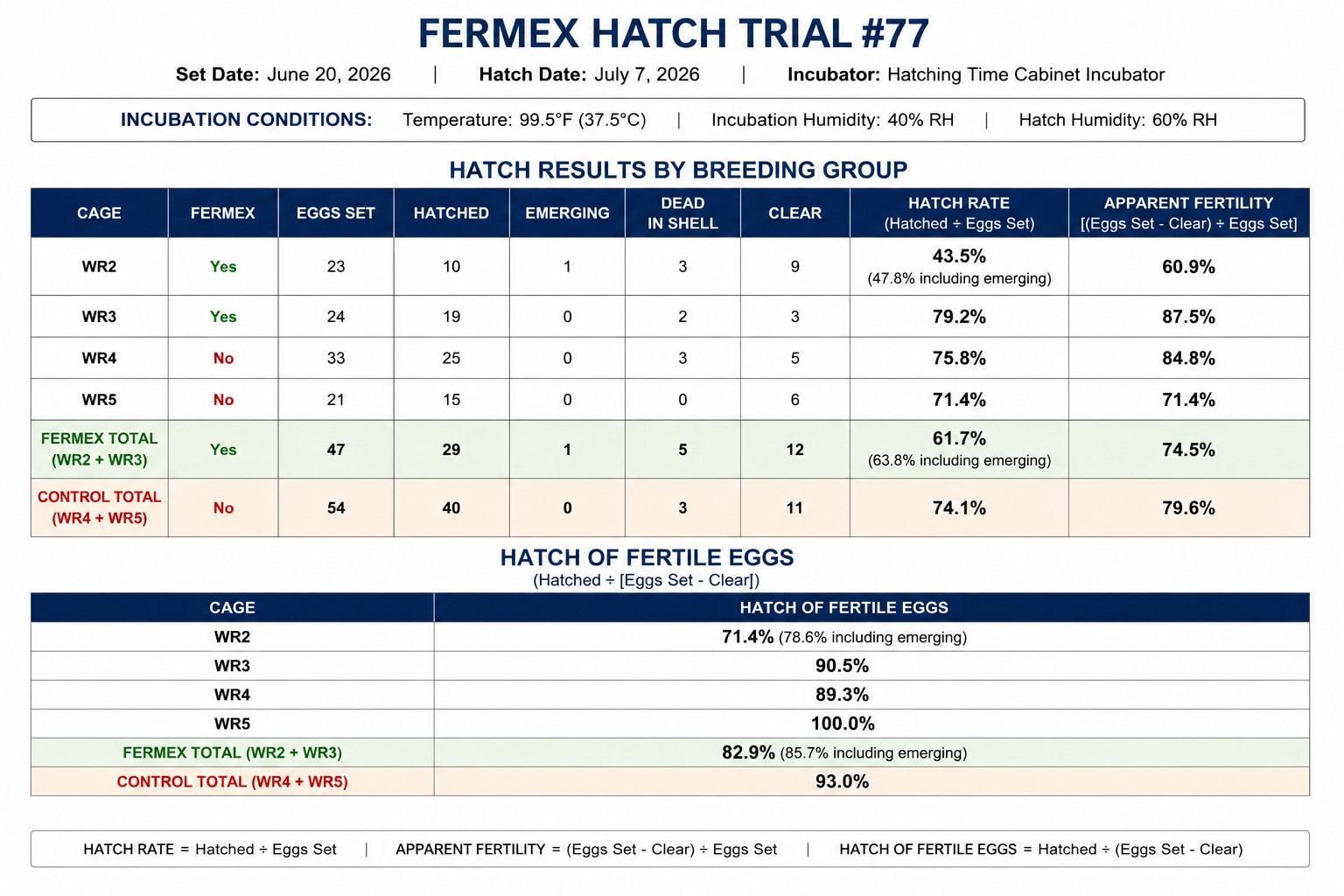
Hatch Trial #77 compares Coturnix jumbo breeding groups receiving free-choice Fermex with control groups under identical incubation conditions. This report includes hatch rate, apparent fertility, hatch of fertile eggs, and ongoing heritage turkey poult observations as part of a long-term field evaluation.
Set Date: June 20, 2026
Hatch Date: July 7, 2026
Incubator: Hatching Time Cabinet Incubator
Incubation Conditions
Temperature: 99.5°F (37.5°C)
Incubation Humidity: 40% RH
Hatch Humidity: 60% RH
Trial Design
This hatch represents the first documented comparison of breeding groups receiving free-choice Fermex versus control groups receiving the standard feeding program.
All breeder groups consisted of jumbo Coturnix quail. The breeders were closely age-matched, with no more than approximately one week of age difference between groups. This helps reduce breeder age as a source of variation, although genetic line, individual pen fertility, mating activity, and other management differences may still influence the results.
Treatment Groups
Fermex
WR2
WR3
Show Pro Layer Feed with free-choice Fermex
Control
WR4
WR5
Show Pro Layer Feed only, with no Fermex
Because each treatment consists of different breeding groups, this trial should still be considered preliminary. The close age match strengthens the comparison, but it does not eliminate differences related to genetics, breeder condition, male performance, fertility history, or pen-level variation.
Initial Observations
The control breeding groups produced higher hatch percentages in this first trial. They also experienced fewer late embryo losses despite setting more eggs.
However, these results should not be interpreted as evidence that Fermex negatively affected hatchability. WR2 has demonstrated lower reproductive performance in previous hatches, while WR4 has consistently ranked among the stronger breeding groups. Because the treatment groups are not genetically identical, breeding group performance remains a significant confounding factor.
At this stage, the results should be viewed as baseline data rather than a conclusion regarding the effectiveness of Fermex.
Ongoing Data Collection
Hatchability is only one component of evaluating a breeder supplement. Additional performance measurements are being collected as this project continues.
The following data will be added to future reports:
Seven-day poult/chick mortality
Chick and poult vigor
Growth performance
Long-term breeder fertility and hatchability trends
Additional hatch cycles to increase sample size
These metrics will provide a more complete picture of whether Fermex influences not only hatch success but also early survivability and overall bird performance.
Turkey Poult Observations
In addition to the Coturnix breeder trial, Fermex has been provided to heritage turkey poults beginning immediately after hatch.
At the time of this report:
Group 1: 15 poults, approximately 15 weeks of age
Group 2: 10 poults, approximately 10 weeks of age
Group 3: Approximately 50 poults from the most recent hatch
All poults received Fermex from the day of hatch.
Only one mortality has been observed among the three groups. That poult exhibited a severe crossbeak deformity shortly after hatch and was not expected to survive due to its congenital condition. No unexplained mortalities have occurred in any of the groups.
Conclusion
This report represents the first hatch in an ongoing evaluation of Fermex as a breeder and hatch supplement.
Current data do not support drawing conclusions regarding the product's effect on fertility or hatchability because treatment groups differ genetically and historically in reproductive performance. Continued data collection across multiple hatch cycles, combined with one-week mortality, chick quality, poult survival, and growth measurements, will provide a much stronger basis for evaluating any biological effect associated with Fermex.
Week’s 2 & 3 Observations
Week 2 was fairly uneventful, the quail chicks which had been on the supplement since hatch continued to grow. All seemed consistent size. I continued to sort breeders into the groups and that should be finished by week 4, I am simply waiting for all to mature. I could not discern a good way to feed to the Bresse chicken breeders and not lose to the rodents, so I decided to add to the feed. I am measuring out feed daily and egg production is steadily increasing. We have had some odd weather, it was very hot and dry, the birds all seem confused this early in the year.
Week 3, I place the quail chicks onto wire, with heat, however one died. We are now at 19 and all still evenly sized. They have free choice supplement and consume it easily and consistently.
The quail breeders who have been receiving it, jump at it when I refill it, they are very excited when I put it back in. They are already laying, but they are oldest. I will begin testing their fertility in week 4 as the eggs are becoming consistent size now.
I have bresse chicks on it since hatch and mortality is low. One from each group only.
The Bresse breeders are still receiving it in their food daily and egg laying is upticking in size and consistency. They have been receiving it 3 weeks and I will set eggs next week to see if mortality of the chicks changes.
The weather turned chilly again and the button quail are sensitive to these changes, I decided yesterday to offer them some free choice by cage cup in hopes of boosting their vigor.
One last note: I have one Bresse breeder group and the cock bird is hard on the hen’s backs. Overmating and he will be replaced. I had put saddles on the girls in March but they have since removed them. What caught my attention is their feathering is improving. I am unsure if it is because he is slowing on mating or something else. I plan to continue to observe that pen for more changes.
Week 1 Observations
This study began after a manufacturer reached out and offered a gut health supplement for evaluation. The product was provided at no cost, with no input on trial design, data collection, or reporting. Given the opportunity to test it under real breeder conditions, I chose to run a structured field study focused on measurable outcomes.
The supplement used in this trial is a fermented, seaweed-based product processed using lactic acid bacteria. It is intended to support gut health, with the goal of improving overall bird condition, nutrient utilization, and resilience under typical production stressors.
In this study, I’m not evaluating claims directly, but observing whether measurable changes occur in growth consistency, vitality, feather quality, mortality, and long-term reproductive performance, including fertility and hatchability.
Short clip of chicks consuming the supplement during the first week.
Trial Setup
The supplement was delivered in a quantity sufficient to support approximately five months of use.
A breeder cage from Wynola Ranch was provided to conduct the adult portion of the trial.
On Wednesday, the first batch of quail hatched. Twenty chicks were placed in a brooder and provided clean water, the test supplement, and Show Pro Quail Starter feed. The brooder was set up with a brooder plate, dry stall pellets, and maintained in a draft-free environment.
As of this point, no mortalities have been observed. The chicks consumed the initial 3.9 g of supplement within the first 24 hours, indicating immediate acceptance.
On Saturday, April 4, a group of 7-week-old Coturnix quail—13 hens and 3 males—were moved into the Wynola Ranch breeder cage. Each bird was evaluated for physical defects, and none were identified. The group was weighed and found to be uniform in size.
These birds are being maintained on Show Pro layer/breeder feed and were provided 15.2 g of supplement upon introduction. One bird began consuming the supplement immediately, with others following shortly after.
Additional breeder groups have been sorted and will be incorporated into the trial as it progresses.
Early Observations
From a breeder standpoint, the first thing I notice with any new supplement is whether birds accept it without hesitation. In this case, both chicks and adults showed immediate interest. There was no delay in consumption, which is often the first barrier with any new input.
The supplement itself has a mild, pleasant odor and a crumble consistency that works well across age groups. The particle size is appropriate for both chicks and adult birds, which makes it easy to offer without modification.
At five days old, the chicks appear uniform in size and remain active. There are no early signs of lagging individuals, which is one of the first indicators I watch for when evaluating overall development.
The Bresse group presents a different challenge. Because they are maintained outdoors, accurately measuring supplement intake is more difficult due to environmental factors such as rodents and general feed loss. For now, I’ve incorporated the supplement into their daily feed ration while I work toward a more controlled method of tracking consumption.
At this stage, the most important indicators are acceptance, activity, and uniformity. All three are present so far, which provides a solid baseline moving into the next phase of observation.
What I’m Watching Next
Moving into next week, I’ll be adding a control group of 20 chicks from this week’s hatch to establish a direct comparison against the supplemented group.
I’ll also be finishing setup of the breeder groups and continuing to track supplement intake as consistently as possible.
Another area I’ll be paying closer attention to is manure condition on the poop trays compared to non-supplemented groups, as this can provide an early indicator of digestive response.