

THE BRYANT’S ROOST BRESSE PROJECT
American Bresse Chickens: Learn, Hatch & Cook
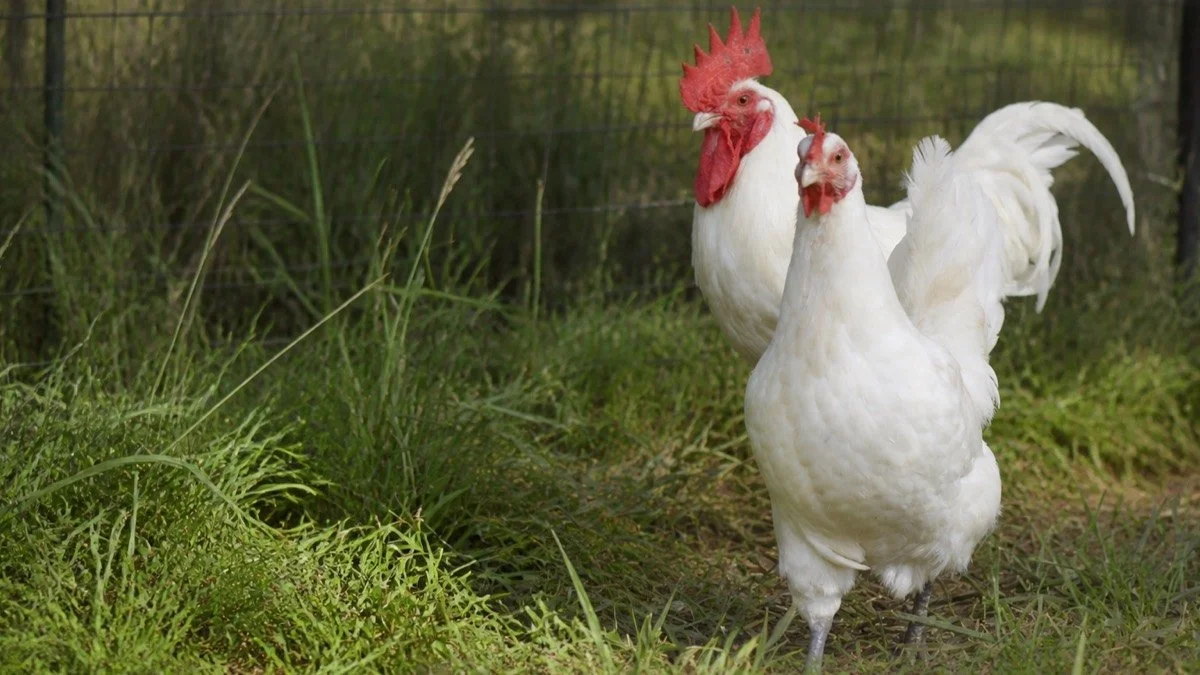
Known for their distinctive white feathers and blue legs, American Bresse chickens offer homesteaders something increasingly rare: the opportunity to build a self-replacing meat flock with careful selection behind it.
Explore the breed, follow our breeding program, shop hatching eggs, and learn how to make the most of the birds you raise.

About the Author
Jennifer Bryant is a poultry breeder at Bryant’s Roost and co-host of the Poultry Nerds Podcast. She has earned competitive show awards with Cochins and Orpingtons and holds certified training in poultry incubation and hatchability management.
Her breeding program emphasizes structural integrity, focused meat selection, frame length development, bone refinement, and carcass evaluation. Jennifer studies documented French Bresse standards and applies those principles through active breeder selection, processing analysis, and performance-based testing in her White Bresse-type line.
The Bresse Hatching Egg

The Bresse Hatching Egg: Foundation of the Program
Every serious meat breeding program begins with the egg. You can purchase them here
In the French system, strict standards govern not only the finished bird, but also breeder management, flock structure, and traceability. While AOP certification applies within the Bresse region of France, the principle remains universal: the integrity of the carcass begins with the integrity of the breeding stock.
At Bryant’s Roost, selection begins before incubation.
What I Evaluate in a Bresse Hatching Egg
Egg Size & Uniformity
Breeder hens must lay consistent, well-formed eggs. Uniformity supports even embryonic development and predictable hatch timing.
Shell Quality & Strength
Thin or fragile shells compromise moisture regulation and transport stability. I select for strong, well-calcified shells that protect the developing embryo.
Fertility & Hatch Performance
Eggs are not evaluated by appearance alone. Fertility rates, hatch percentages, and early chick vigor inform ongoing breeder selection decisions.
Why Hatchability Matters in a Meat Program
Many breeders focus exclusively on adult body traits. However, poor hatch performance weakens genetic progress and compromises long-term line stability.
Because I hold formal certification in poultry incubation, hatch metrics are tracked alongside structural traits. Breeders are selected not only for frame and meat yield potential, but for reproductive efficiency and chick viability.
Structural excellence without reproductive strength is not sustainable.
Hatching Egg Shipping Protocol
At Bryant’s Roost, hatchability begins long before an egg is packed.
Breeder birds are fed a custom-formulated layer ration designed to support not only hen health, but embryonic development. An egg is only as strong as the nutrition behind it. Structural integrity, shell quality, and early chick vigor all begin with breeder management.
Egg Collection & Grading
Nests are kept clean and monitored daily.
Eggs are shipped unwashed to preserve the natural protective bloom.
Each egg is individually graded for:
Size and uniformity
Shell integrity
Proper shape
Cleanliness
Only eggs meeting structural and quality standards are selected for shipment.
Packaging & Protection
Approved eggs are packaged in our specially designed EggFoam™ protective shippers and double boxed for added impact resistance during transit.
This system is designed to reduce vibration, stabilize orientation, and protect the air cell during shipping.
Upon Arrival: Rest & Incubation Protocol
Because shipped eggs may experience air cell disruption, proper handling upon arrival is critical.
Cool Weather Shipping
Place eggs upright (large end up).
Allow a vertical rest period of up to 12 hours.
Pre-warm eggs gradually before incubation to prevent condensation on the shell.
Warm or Hot Weather Shipping
Place eggs directly into a vertical incubator.
Leave the turner off for up to 12 hours to allow the air cell to stabilize.
We do not recommend horizontal incubation for shipped eggs. Upright incubation supports air cell integrity and improves hatch potential.
Incubation Guidelines (Buyer Responsibility)
Buyers are responsible for maintaining stable incubation conditions:
Temperature: 99.5°F
Humidity: 40–45% (Days 1–18)
Proper turning throughout development
Turning is critical for embryonic development and prevention of membrane adhesion.
To reduce handling stress, eggs should remain inside the incubator during Days 1–18. Candling during this period is not recommended.
Lockdown (Day 18)
Candling may be performed quickly and efficiently.
Transfer eggs to the hatcher on a grip mat.
Increase humidity to 60%.
Do not open the incubator during hatch.
Remove chicks only once they are dry and fully fluffed and all viable eggs have completed hatch.
Important Note
Hatch rates are influenced by shipping conditions, handling, and incubation stability. While we carefully manage breeder nutrition, grading, and packaging, successful incubation ultimately depends on proper environmental control after arrival.
Breeder Selection: Structural Integrity First
At Bryant’s Roost, breeder selection follows a disciplined, frame-first model influenced by documented French Bresse standards and reinforced through hands-on carcass evaluation.
Selection does not begin with color.
It begins with structure.
1. Frame & Back Width
The foundation of a meat bird is skeletal architecture.
Breeders are selected for:
Long body length
Wide, well-developed back
Balanced stance
Correct leg placement
Back length correlates directly with potential breast filet length. Narrow or short-bodied birds are removed from the breeding pool regardless of other traits.
2. Breast & Filet Development
Breast evaluation is conducted through physical handling and post-processing analysis.
Desired traits include:
Wide muscle development along the keel
Consistent filet length
Balanced depth without coarse heaviness
Birds that carry narrow breast structure or taper prematurely are culled.
Selection favors functional meat distribution, not exaggerated bulk.
3. Fine Bone & Refinement
True Bresse-type structure emphasizes refinement.
Breeders are evaluated for:
Clean hock joints
Refined shank structure
Slender head and neck
Overall skeletal balance
Coarse bone reduces edible yield and detracts from carcass quality. Fine bone combined with adequate muscle deposition produces a superior table bird.
4. Carcass Evaluation & Yield
Selection decisions are informed by processing analysis.
Evaluation includes:
Skin integrity
Meat distribution
Fat placement
Breast-to-frame proportion
Overall dressed yield
Structural assumptions are verified through real-world processing results. Breeding decisions are based on measurable outcome, not appearance alone.
5. Reproductive Performance
A breeding program must remain sustainable.
Breeders are monitored for:
Fertility rates
Hatch percentage
Chick vigor
Egg consistency
Structural excellence without reproductive strength is not retained in the program.
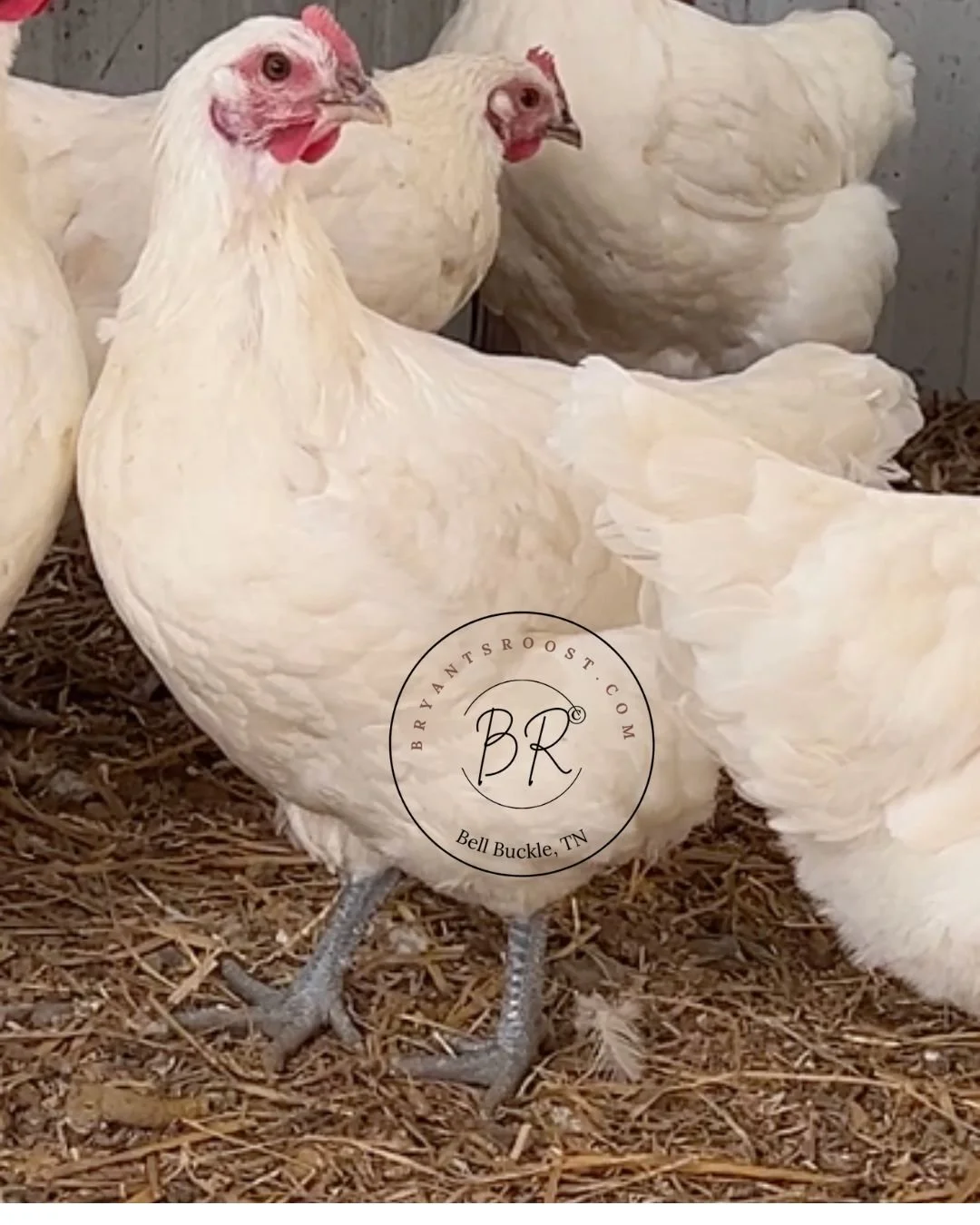
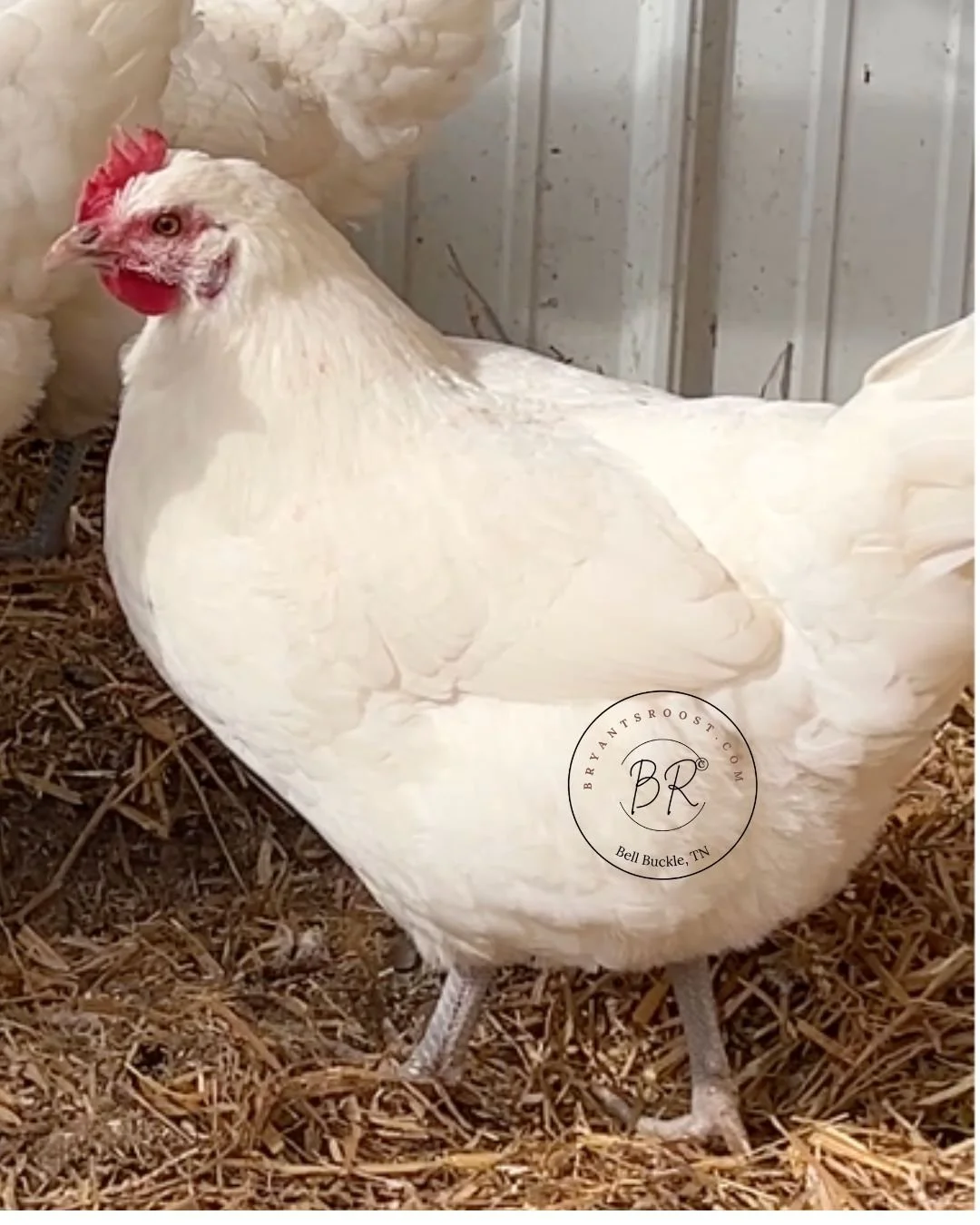
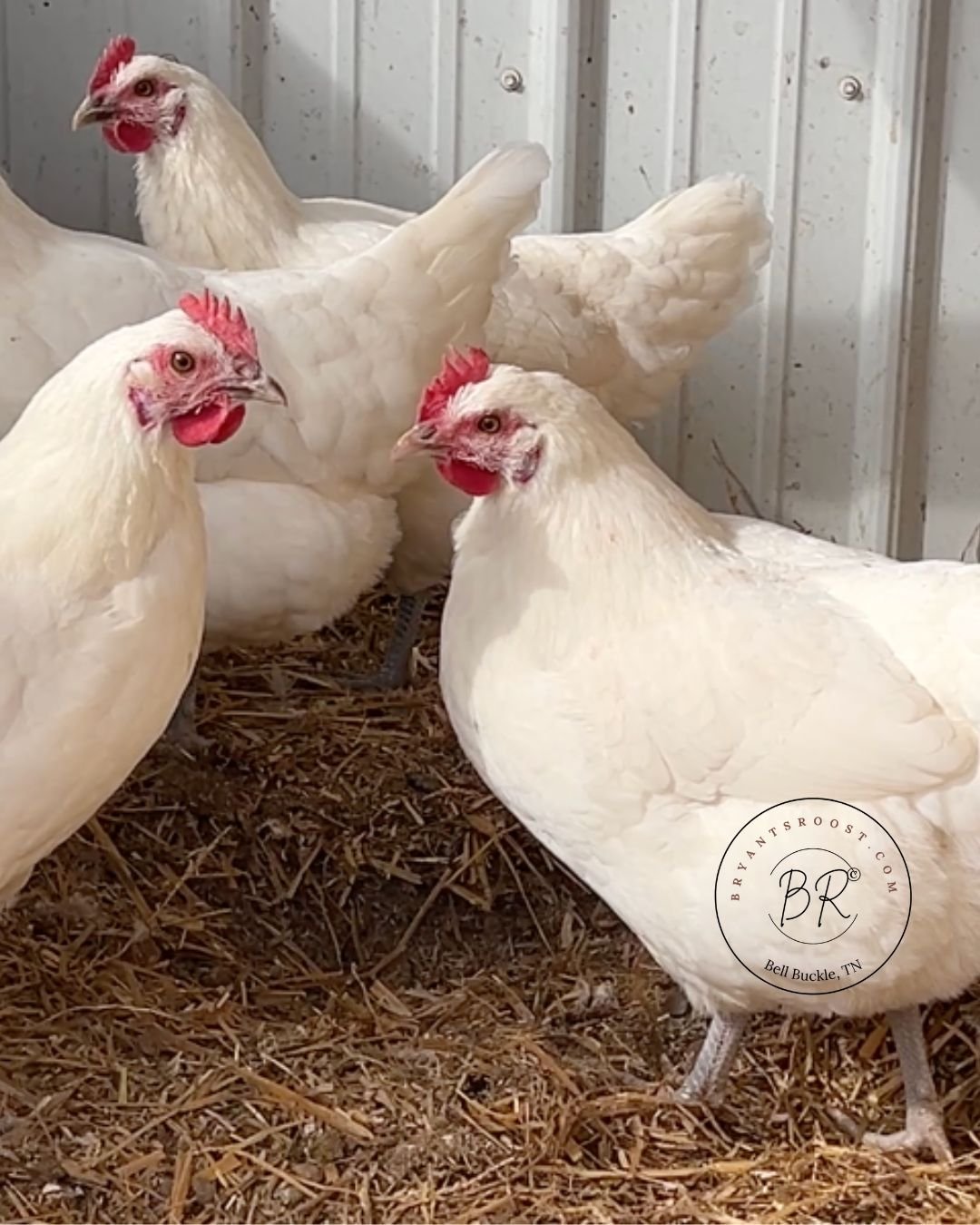
Pictured are some young pullets retained for breeders. First we see the pure white plumage, the blue legs, and compact build. The tail set is low to elongate the back. The chest is deeper to fill out breast meat. The backs are wide from nape to tail. Wings are held in proper position, tight against the body. Keels are felt for straightness and length. Space between the legs for width and straight legs to balance and support the bird. Each pullet will be hand evaluated by Jennifer at point of lay and must be at least 5#. Once she approves the pullets, they will be matched with appropriate males to further the lines.
Uniformity Requires Discipline
Uniformity is a long-term breeding goal. It is not achieved through hope, nor through keeping every bird. It is achieved through strict, consistent culling.
In any developing meat line, variation appears in:
Frame length
Back width
Breast distribution
Bone refinement
Growth pattern
Egg size consistency
If variation is tolerated in the breeding pen, it compounds in the next generation.
For that reason, only birds that meet structural and performance criteria are retained as breeders by Jennifer. Birds that fall short — even if healthy — are removed from the program and put into the freezer.
Culling Is Not Waste
Culling is not failure. It is refinement. Birds removed from the breeding pool are processed and utilized for the Bryant family. They contribute to evaluation data and provide direct feedback on carcass traits and flavor. This allows selection decisions to be grounded in:
Actual meat yield
Texture
Skin quality
Fat distribution
Eating quality
Smiles
Progress toward uniformity is measured generation by generation.
Bresse-Type Birds vs. Cornish Cross
The Bresse model differs fundamentally from commercial Cornish Cross production.
Cornish Cross are designed for:
Rapid growth
Maximum breast yield in minimal time
Confinement-based feed conversion
Bresse-type birds are selected for:
Structural balance
Flavor development
Fine bone and refined carcass
Moderate, sustainable growth
They are not intended to compete with Cornish Cross in speed.
They are intended to produce a more nuanced eating experience — with firmer texture, deeper flavor, and balanced meat distribution.
Uniformity in this type of bird takes time and disciplined selection.
Why This Matters
A consistent line does not appear overnight.
It is built through:
Strict breeder retention standards
Objective carcass evaluation
Hatch performance tracking
Generation-by-generation refinement
At Bryant’s Roost, birds that do not meet breeder standards become part of the evaluation process — and part of our table — while the line continues to improve.
Uniformity is the goal. Discipline is the method.

Bresse French Standard in English
Credit to https://bresse-gauloise-club-de-france.e-monsite.com/pages/standard-de-la-race.html