

Fermex Hatch Trial : Preliminary Hatch Results
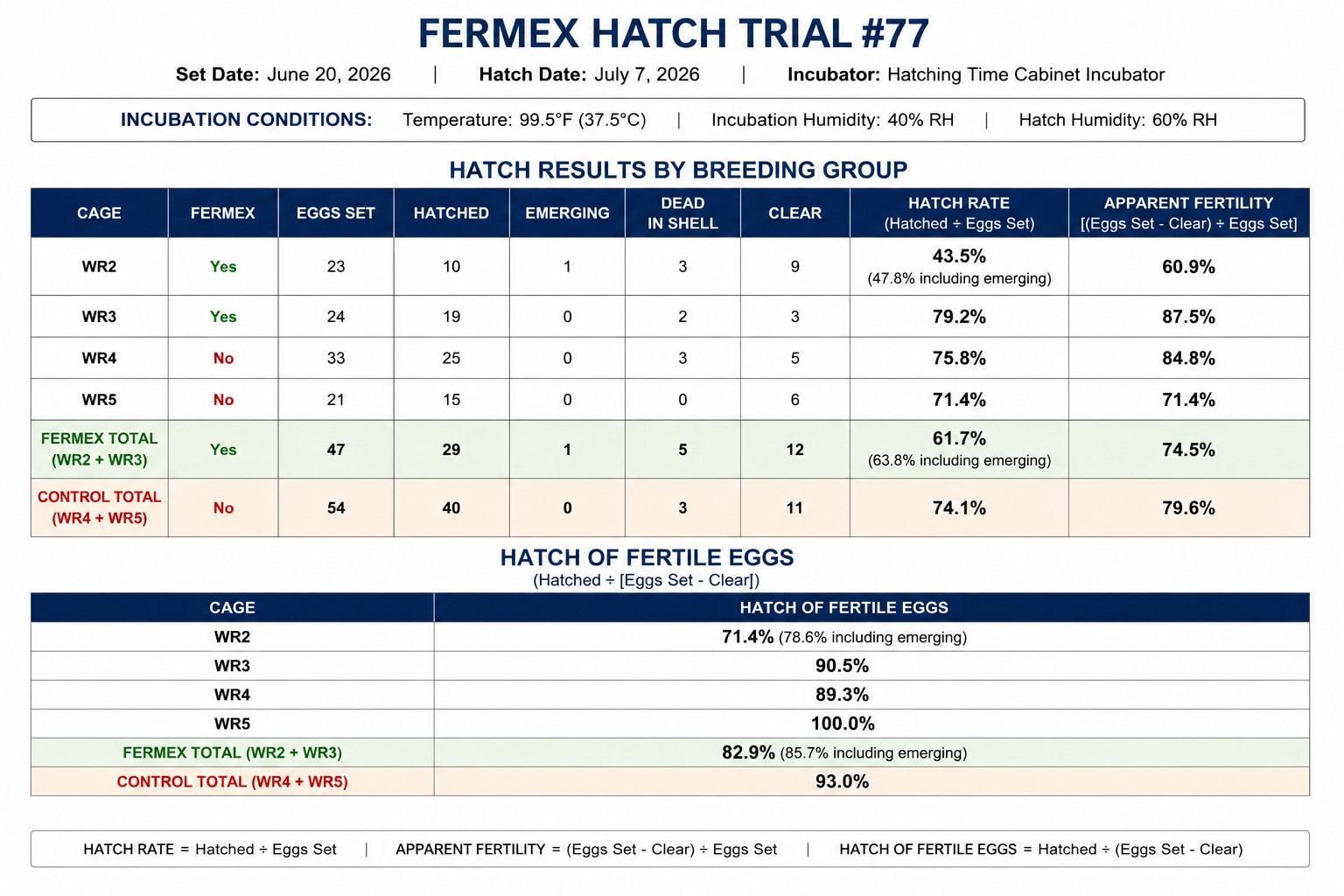
Set Date: June 20, 2026
Hatch Date: July 7, 2026
Incubator: Hatching Time Cabinet Incubator
Incubation Conditions
Temperature: 99.5°F (37.5°C)
Incubation Humidity: 40% RH
Hatch Humidity: 60% RH
Trial Design
This hatch represents the first documented comparison of breeding groups receiving free-choice Fermex versus control groups receiving the standard feeding program.
All breeder groups consisted of jumbo Coturnix quail. The breeders were closely age-matched, with no more than approximately one week of age difference between groups. This helps reduce breeder age as a source of variation, although genetic line, individual pen fertility, mating activity, and other management differences may still influence the results.
Treatment Groups
Fermex
WR2
WR3
Show Pro Layer Feed with free-choice Fermex
Control
WR4
WR5
Show Pro Layer Feed only, with no Fermex
Because each treatment consists of different breeding groups, this trial should still be considered preliminary. The close age match strengthens the comparison, but it does not eliminate differences related to genetics, breeder condition, male performance, fertility history, or pen-level variation.
Initial Observations
The control breeding groups produced higher hatch percentages in this first trial. They also experienced fewer late embryo losses despite setting more eggs.
However, these results should not be interpreted as evidence that Fermex negatively affected hatchability. WR2 has demonstrated lower reproductive performance in previous hatches, while WR4 has consistently ranked among the stronger breeding groups. Because the treatment groups are not genetically identical, breeding group performance remains a significant confounding factor.
At this stage, the results should be viewed as baseline data rather than a conclusion regarding the effectiveness of Fermex.
Ongoing Data Collection
Hatchability is only one component of evaluating a breeder supplement. Additional performance measurements are being collected as this project continues.
The following data will be added to future reports:
Seven-day poult/chick mortality
Chick and poult vigor
Growth performance
Long-term breeder fertility and hatchability trends
Additional hatch cycles to increase sample size
These metrics will provide a more complete picture of whether Fermex influences not only hatch success but also early survivability and overall bird performance.
Turkey Poult Observations
In addition to the Coturnix breeder trial, Fermex has been provided to heritage turkey poults beginning immediately after hatch.
At the time of this report:
Group 1: 15 poults, approximately 15 weeks of age
Group 2: 10 poults, approximately 10 weeks of age
Group 3: Approximately 50 poults from the most recent hatch
All poults received Fermex from the day of hatch.
Only one mortality has been observed among the three groups. That poult exhibited a severe crossbeak deformity shortly after hatch and was not expected to survive due to its congenital condition. No unexplained mortalities have occurred in any of the groups.
Conclusion
This report represents the first hatch in an ongoing evaluation of Fermex as a breeder and hatch supplement.
Current data do not support drawing conclusions regarding the product's effect on fertility or hatchability because treatment groups differ genetically and historically in reproductive performance. Continued data collection across multiple hatch cycles, combined with one-week mortality, chick quality, poult survival, and growth measurements, will provide a much stronger basis for evaluating any biological effect associated with Fermex.