

Building an Egyptian Coturnix Line: Why Selective Breeding Matters
Quick Look
My Egyptian Coturnix line originated from a recessive gene hidden within my original Pharaoh breeding stock.
I isolated the mutation and developed a dedicated Egyptian line while simultaneously breeding the gene out of my Pharaoh line.
Both lines have now been maintained separately for more than six years.
Establishing a true breeding line requires years of selection, not simply producing birds of the desired color.
Mixing birds from multiple breeders introduces unknown genetics and hidden recessive traits that can take many generations to sort back out.
When people ask where my Egyptian Coturnix came from, they're often surprised by the answer. I didn't purchase an established Egyptian line from another breeder. The recessive Egyptian gene was already hiding within my original Pharaoh breeding stock. Like many recessive traits, it remained invisible until the right pairing produced Egyptian chicks. At that point, I had a choice. I could continue allowing the mutation to appear randomly in my Pharaoh line, or I could intentionally develop it into a separate breeding project. I chose the second option.

The Bryant's Roost Egyptian Line
Quick Look
Hatching eggs from Bryant's Roost's established Egyptian Coturnix breeding line.
Breeds true
Selected for consistency, fertility, hatchability, and overall quality—not color alone.
NPIP Certified flock.
Carefully packaged in EggFoam for maximum shipping protection.
Egyptian Coturnix Hatching Eggs
Our Egyptian Coturnix line didn't begin with birds purchased from multiple breeders. It began with a recessive gene discovered within our original Pharaoh breeding program.
Rather than allowing the mutation to appear randomly, we made the decision to establish a dedicated Egyptian breeding line while simultaneously breeding the Egyptian gene out of our Pharaoh line. More than six years later, those two lines continue to be maintained separately through careful record keeping and selective breeding.
That history matters.
When you purchase hatching eggs from Bryant's Roost, you're receiving eggs from a breeding program that has been intentionally developed over multiple generations. Our goal has never been to simply produce Egyptian-colored birds. Every generation is selected for the traits that make a reliable breeding line, including fertility, hatchability, vigor, temperament, and consistent production.
Because every bird carries hidden genetics, developing a predictable breeding line requires years of selection. We believe consistency is one of the most valuable qualities a breeder can offer, and it is something that cannot be created overnight.
Every order is collected fresh, carefully inspected, and packaged in EggFoam shipping inserts to provide the best possible protection during transit. While shipping hatching eggs always involves variables beyond our control, proper packaging gives your eggs the best opportunity to arrive safely.
Whether you're starting your first Egyptian breeding project or adding quality genetics to an existing program, we appreciate the opportunity to be part of your journey.
What You'll Receive
Fresh Egyptian Coturnix hatching eggs.
Eggs from our established Bryant's Roost Egyptian breeding line.
NPIP Certified breeding stock.
Eggs packaged in EggFoam shipping materials.
Detailed incubation instructions included with every order.
Why Choose Bryant's Roost?
More than six years maintaining this established Egyptian line.
B.S. in Animal Science.
Selective breeding focused on consistency, not simply color.
Extensive experience shipping hatching eggs nationwide.
Educational support before and after your purchase through Bryant's Roost and the Poultry Nerds Podcast.
Before You Order
Hatching eggs are a perishable product. Hatch rates are influenced by many factors, including shipping conditions, incubation practices, equipment, and breeder experience. Because these variables are outside our control once eggs leave the farm, hatchability cannot be guaranteed.
We strongly recommend allowing shipped eggs to rest in cold weather and to set immediately in hot weather before incubation and following proper incubation procedures to maximize hatch success.
Continue Learning
New to Coturnix quail?
Download our Free Coturnix Brooding eBook to learn how to successfully brood your chicks from hatch through the critical first weeks of life.
Want to better understand shipped eggs and incubation?
Visit the Poultry Nerds research library and educational articles for science-based information on incubation, genetics, and breeder selection.
As I began selecting Egyptian birds, I was also selecting my Pharaoh line in the opposite direction. Every breeding season, I worked to strengthen the Egyptian line while removing the recessive gene from the Pharaoh line. Over time, those two populations became distinct. Today, more than six years later, they continue to exist as separate breeding lines, each selected for its own purpose.
This is an important distinction that is often overlooked. Producing an Egyptian-colored bird is not the same as establishing an Egyptian line. Color is controlled by one small piece of a bird's genetics, but a breeding line is defined by far more than feather color. Fertility, hatchability, egg production, body size, temperament, growth rate, vigor, and overall consistency are all traits that must be selected over multiple generations. True breeding lines are built through patience and selection, not by chance.
One of the most common pieces of advice given to new breeders is to purchase birds from several different breeders and mix them together to "improve genetics." While introducing outside genetics certainly has a place in a breeding program, randomly combining multiple bloodlines often creates more problems than it solves. Every breeder has spent years making different selection decisions. Some have selected for larger eggs, others for color, others for size or production. Along with those visible traits come countless hidden genes and recessive mutations that may never have been identified.
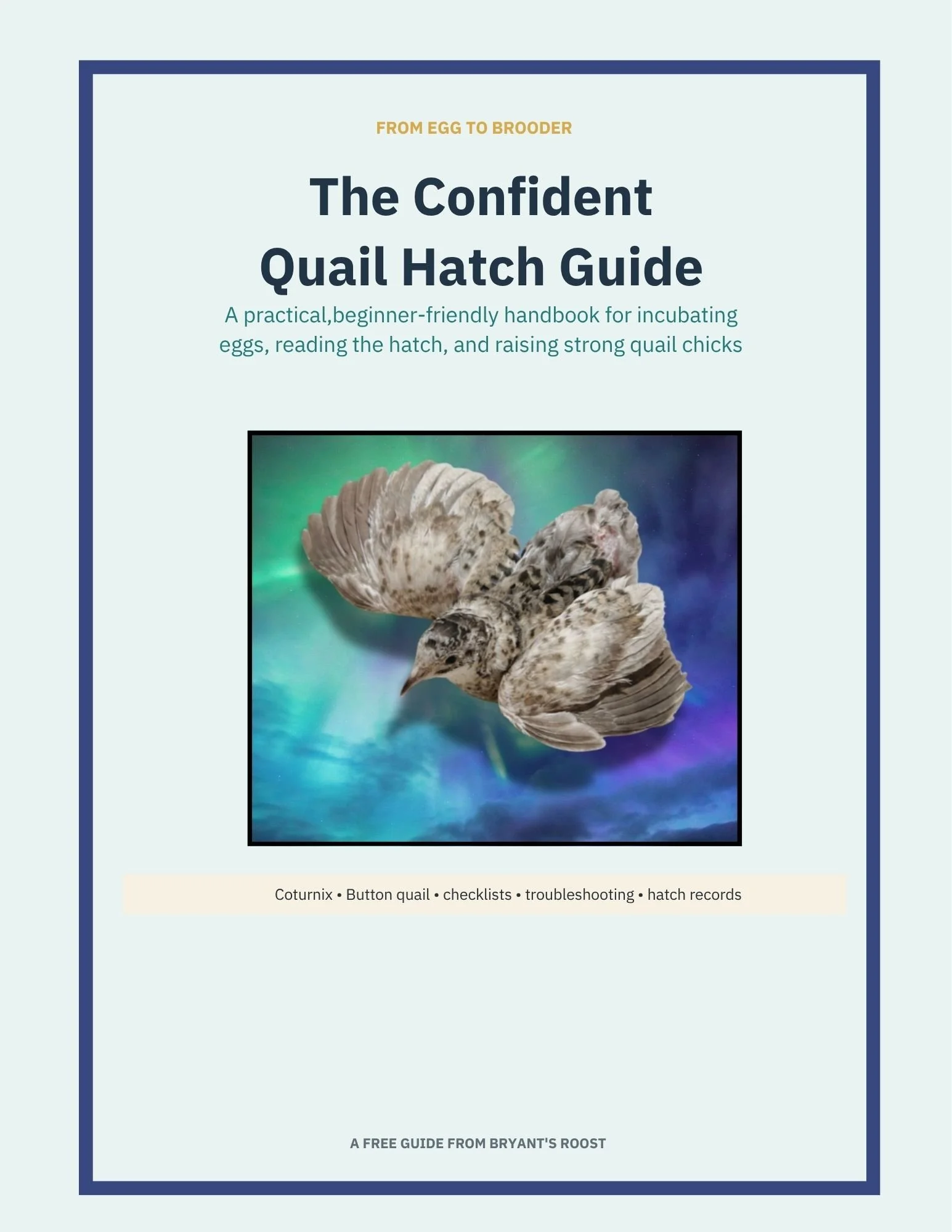
The Confident Quail Hatch Guide: From Egg to Brooder
Take the guesswork out of hatching quail with this practical, beginner-friendly guide from Bryant’s Roost.
The Confident Quail Hatch Guide walks you through the process from selecting and setting eggs to incubation, lockdown, hatch day, and the first weeks in the brooder. It includes guidance for Coturnix and Button quail, along with troubleshooting tips to help you make better decisions without constantly adjusting your incubator.
Inside, you’ll learn:
How to select, store, and handle hatching eggs
Special handling considerations for shipped eggs
How to prepare and test your incubator
The roles of temperature, humidity, turning, and ventilation
What to expect during candling and lockdown
Why assisting a hatch is not recommended
How to prepare a safe, warm, draft-free brooder
Important differences when raising tiny Button quail chicks
How to troubleshoot a disappointing hatch
How to calculate and interpret your hatch rate
You’ll also receive a printable hatch checklist and hatch-record page to help you track results and improve future hatches.
Created by Jennifer Bryant, owner of Bryant’s Roost, co-host of the Poultry Nerds Podcast, and creator of Beyond the Egg.
Digital PDF download. No physical product will be shipped.
Price: FREE
Want to go beyond the basics? Visit IncubationMasterclass.com to learn more about Jennifer’s complete Incubation Masterclass.t
Once those birds are mixed together, the genetics become much harder to predict. Recessive traits can remain hidden for generations before unexpectedly appearing. Traits that seem to disappear may simply be carried silently through the population, only to reappear years later when two carriers are mated. At that point, it becomes nearly impossible to know which breeder introduced a particular gene or how long it has been present in the flock.
I often compare it to making a bowl of soup. Once all the ingredients have been stirred together, you can't separate them back into their original components. Genetics work much the same way. Every new bird brings thousands of genes into a breeding program, most of which cannot be seen by simply looking at the bird. The more unrelated bloodlines that are mixed together, the more difficult it becomes to create a flock that breeds consistently generation after generation.
That doesn't mean outside genetics should never be introduced. In fact, carefully selected outcrosses can be an important tool. The key is intentionality. Every bird should enter a breeding program for a specific reason, with a clear understanding of the traits you hope to gain and the traits you may also be introducing. Without a plan, each outcross increases genetic variability and extends the amount of selection required before the line becomes predictable again.

AD: The monthly magazine by the Homesteading Family
One of the most rewarding parts of maintaining these Egyptian and Pharaoh lines for more than six years is the consistency they now produce. When I hatch chicks, I have a much better idea of what to expect because those lines have been shaped by years of careful selection rather than constant mixing. That predictability is ultimately what defines a breeding line. It isn't the color of the feathers—it's the confidence that the next generation will resemble the one before it.
Selective breeding is a long-term commitment. It requires resisting the temptation to chase every new variety or continually add unrelated birds simply because they're available. The birds we see today are the result of breeding decisions made years ago, and the birds we'll hatch five years from now are determined by the decisions we make today. Building a true breeding line takes time, but the consistency it produces is worth the patience.
Key Takeaways
Establishing a breeding line takes multiple generations.
Color alone does not define a breeding line.
Mixing unrelated bloodlines increases genetic variability.
Selection creates predictability.
Jennifer Bryant is the founder of Bryant's Roost and co-host of the Poultry Nerds Podcast. She holds a B.S. in Animal Science and has completed advanced education in poultry incubation through the University of North Carolina Poultry Science program. Jennifer is passionate about combining poultry science with practical experience to help poultry keepers make informed, evidence-based decisions for healthier, more productive flocks.
Breeder's Thought:
Feather color may catch our attention, but predictability is what defines a breeding line. Every mating is an investment in the birds you'll be raising years from now.
-
Yes. Recessive genes can be carried by birds that show no outward signs of the trait. If two carriers are eventually paired together, the recessive trait may suddenly appear, even if it hasn't been seen for several generations.
-
No. Producing a bird with the correct feather color is only the beginning. An established breeding line consistently reproduces its desired characteristics—including color, fertility, hatchability, body type, temperament, and production traits—over many generations.
-
Every breeding program has its own genetic history. Mixing multiple bloodlines introduces unknown dominant and recessive genes, making future generations much less predictable. While outcrossing has its place, it should always be done with a specific breeding goal in mind.
-
They can be greatly reduced through careful selection and test breeding. Proving a recessive gene has been completely eliminated is difficult but can be done. Birds that appear normal may still carry hidden recessive alleles unless their genetics have been thoroughly evaluated over multiple generations.
-
A line that breeds true consistently produces offspring with predictable characteristics. While no breeding program is perfect, established lines should produce far fewer surprises than newly mixed populations.
-
Not necessarily. Purchasing from multiple breeders can increase genetic diversity, but it also introduces unknown traits and hidden recessive genes. For breeders working toward a specific goal, carefully planned outcrosses are often more effective than mixing unrelated birds without a long-term selection plan.
Essentially it immediately undos years of breeding by the original breeder.
-
Color is controlled by relatively few genes, while traits such as egg production, fertility, body size, growth rate, and temperament are influenced by many genes. Long-term success comes from selecting the complete bird, not just its feather color.
-
There is no fixed timeline. Depending on your goals and the genetics you begin with, developing a predictable breeding line often requires many generations of careful record keeping and selection. The more unrelated genetics that are introduced, the longer that process may take.
-
One of the most common mistakes is continually adding new birds because they are a different color or came from a different breeder. While exciting, constant introductions make it difficult to identify which birds are actually improving the line and which are introducing unwanted traits.
-
Absolutely. Appearance only tells part of the genetic story. Two Pharaoh quail may look nearly identical, yet one may carry several recessive genes while the other carries none. That's why pedigrees, breeding records, and long-term selection are so valuable.