

Inbreeding Depression in Quail: Why Fertility Is Often the First Sign
When I first discovered Sparkly Fee—or Barred Rock quail, as I like to call them—the entire project began with one sibling pair.
They hatched from my Fee quail originally acquired from H.P. Murray at Gopher Ridge Farm. I bred the brother and sister together and produced more Sparkly Fee offspring. From there, I created a father–daughter group and a mother–son group.
At the time, I was trying to stretch the genetics I had into separate branches. What I could not do was create diversity that was not already present in those two original birds.
By the F3 generation, fertility was suffering. By F4, I was producing only males. I never obtained another female, and the line died.
I did not see missing eyes. I did not see cross beaks or dramatically deformed faces. The line did not announce its genetic trouble with a monster in the incubator.
It quietly stopped reproducing.
In hindsight, I should have taken the Sparkly Fee offspring back to unrelated Fee quail earlier. That would have preserved the phenotype while rebuilding genetic diversity around it.
But we all learn, and the next time I built the line differently.
Quick Look
Inbreeding depression does not always begin with visible deformities. In poultry, some of the earliest measurable warnings are often declining fertility, lower hatchability, embryonic loss, weaker offspring and reduced reproductive fitness. My first Sparkly Fee line began with one sibling pair and eventually died after fertility declined and no more females hatched. When I rebuilt the project, I used multiple unrelated Fee and Sparkly families, created several breeding groups, and selected for the Sparkly Fee phenotype without repeatedly concentrating the entire genome of one pair. Five generations later, the line is Jumbo, homozygous for the selected phenotype, fertile and healthy.
What Is Inbreeding Depression?
Inbreeding is the mating of related animals. Inbreeding depression is the decline in biological performance that can occur as relatedness and homozygosity increase.
Every bird carries genetic variants you cannot see. Some harmful recessive alleles cause no obvious problem when a bird has only one copy. When close relatives are repeatedly bred together, their offspring have a greater chance of inheriting matching copies from both sides.
That can expose undesirable recessive traits.
However, not every harmful combination produces a chick with a visible deformity. Many affect complex performance traits instead:
Fertility
Hatchability
Embryonic survival
Chick vigor
Growth
Egg production
Disease resilience
Adult reproductive success
This is why breeders can miss inbreeding depression until a line is already difficult to recover.
The Myth About Eyes and Facial Structure
A common misconception is that the first signs of excessive inbreeding will be missing eyes, cross beak, crooked toes or obvious changes to the face.
Visible defects can occur, and repeated congenital abnormalities deserve investigation. But they are not a dependable early-warning system for inbreeding depression.
A closed line can look completely normal while producing fewer fertile eggs. Fertile eggs may quit during incubation. Chicks may hatch weaker. Males may mate but fertilize fewer eggs. Females may lay normally while the line’s reproductive fitness declines.
My first Sparkly Fee line looked like the birds I wanted. The phenotype was there. The problem appeared in reproduction.
By the time I produced only males and could not hatch another female, the line had reached a dead end.
Why Fertility Is So Important
Fertility is one of the easiest breeding traits to measure—if you keep records.
A breeder should know:
How many eggs were set
How many were fertile
How many fertile eggs developed
When embryos quit
How many chicks hatched
How many chicks survived
Which male and female group produced them
One poor hatch does not prove inbreeding depression. Incubator temperature, egg storage, breeder age, nutrition, season, male-to-female ratio and disease can all affect results.
The warning is a pattern.
If fertility or hatchability declines across repeated hatches from a related breeding group while other conditions remain consistent, the genetics deserve a closer look.
What the Research Shows
Nordskog and Cheng studied an inbred Leghorn population and found harmful effects on fertility and hatchability. As inbreeding increased within smaller sublines, reproductive losses became more severe.
MacNeil et al. followed Japanese quail through 17 generations under different mating systems. All of the populations were sensitive to inbreeding depression, although birds managed through a planned cyclic system maintained better reproductive fitness than birds subjected to continued intensive breeding.
A 2025 study by Vega-Trejo et al. experimentally compared inbred and outbred male Japanese quail. Eggs fertilized by inbred males had a lower probability of fertilization. That is important because a male can appear normal, complete a mating and still contribute to declining flock fertility.
Leroy (2021) analyzed 30 years of livestock research. Reproduction, survival and production traits generally experienced more inbreeding depression than conformation traits.
In plain English: performance can fail before appearance does.
Research sources:
Nordskog and Cheng, fertility and hatchability in inbred Leghorns
MacNeil et al., mating systems and inbreeding depression in Japanese quail
Vega-Trejo et al., male inbreeding and Japanese-quail fertility
Here’s what that means on my farm: I do not wait for abnormal faces or missing eyes. I monitor fertility, hatchability, chick vigor and the ability of every breeding family to keep reproducing.
What Went Wrong With My First Sparkly Fee Line
My first line had an extremely narrow foundation: one brother and one sister.
Breeding their offspring back through father–daughter and mother–son matings divided the project into branches, but every bird still traced back to the same two founders.
The breeding became tighter while the available genetic variation became smaller.
I successfully concentrated the visible Sparkly Fee phenotype, but I also increased homozygosity across the rest of the genome. That included genes affecting traits I could not see by looking at feather color.
By F3, fertility was falling. By F4, the project could no longer provide the females required to continue.
The phenotype survived longer than the reproductive fitness.
That experience changed the way I build every rare-color project.
How I Rebuilt Sparkly Fee
For the next attempt, I began with Fee quail and an unrelated standard homozygous Sparkly male.
The early offspring were heterozygous for the combination I was building. Instead of narrowing the entire project immediately, I created multiple breeding groups:
Fee females with homozygous Sparkly males
Homozygous Sparkly females with Fee males
HET Sparkly Fee paired with HET Sparkly Fee
Fee females paired with a different homozygous Sparkly male
Additional groups using different Fee females
The goal was to produce the desired phenotype through multiple genetic paths.
I built a large population of heterozygous Sparkly Fee birds from different family combinations. Then I began selecting Jumbo homozygous Sparkly Fee breeders from each group.
I was selecting hard for the genes responsible for the phenotype, size and performance I wanted. At the same time, I was not forcing the rest of the genome to come from one sibling pair.
Recombination reshuffled the broader founder genetics across generations. Multiple families gave me more choices and reduced my dependence on any one bird.
I now have the F5 generation. The birds are Jumbo, homozygous for the selected Sparkly Fee phenotype, healthy and fertile.
I did not get there by avoiding all related matings. I got there by building enough diversity into the foundation before tightening the line.
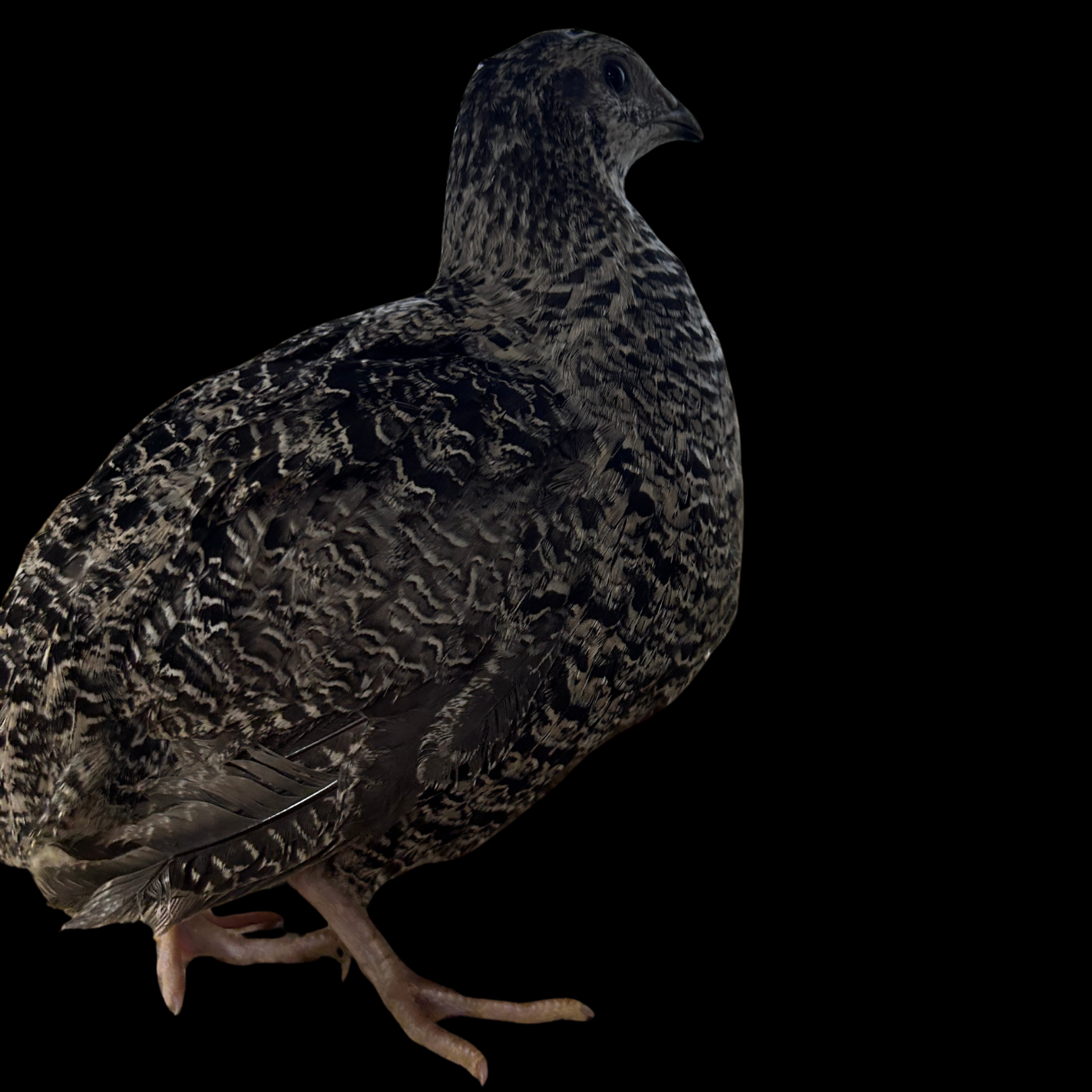
******Shipping will begin September 2026******
Quick Look
Bryant's Roost Barred Rock Quail (Sparkly Fee)
Unique barred feather pattern with a silver "sparkled" appearance
Excellent dual-purpose Coturnix
Calm temperament
Selected for fertility, hatchability, and color consistency
Large hatching eggs
Professionally packaged using EggFoam™
NPIP Certified flock
Includes our Guide to Incubating Coturnix Quail
Bryant's Roost Barred Rock Quail, commonly known as Sparkly Fee, are one of the most eye-catching Coturnix varieties we raise. Their unique feather pattern creates a soft barred appearance with silver highlights that stand out from traditional Coturnix colors.
Our breeding program focuses on more than appearance. Each generation is selected for fertility, hatchability, temperament, and overall quality while preserving the distinctive barred pattern that makes this variety so popular.
Whether you're building a colorful breeding collection or simply want a unique addition to your covey, Bryant's Roost Barred Rock Quail are sure to become a favorite.
What to Expect
These birds mature quickly and begin laying around 7 weeks of age under proper management.
You can expect:
Beautiful barred feather pattern
Calm disposition
Large eggs
Strong fertility
Excellent hatchability
Attractive birds for breeding or exhibition
Shipping
Every order is collected fresh and professionally packaged using EggFoam™ shipping materials to help protect your hatching eggs during transit.
Fresh eggs, proper packaging, and correct incubation practices all contribute to successful hatches.
Homozygous Does Not Mean Inbred Everywhere
A bird can be homozygous for the specific allele responsible for a desired trait without being homozygous across its entire genome.
That distinction matters.
When I say my Sparkly Fee birds are homozygous, I mean they consistently carry the selected phenotype genetics I have been working with. It does not mean every genetic location is identical or that the entire line came from one close mating.
The breeding goal is targeted consistency.
I want the selected color and type to reproduce predictably while retaining enough broader genetic variation to support fertility, hatchability, growth and health.
This is why a breeder should not select only by appearance. Two birds may look identical while carrying very different genetic backgrounds.
Linebreeding Is Not the Enemy
Linebreeding is a tool.
It can reveal recessive traits, increase consistency and help a breeder understand what a family carries. The previous article, Quail Breeding: Do You Really Need New Blood?, explains how tighter breeding exposed Egyptian genetics hiding in my Pharaoh line.
The danger is not one related mating. The danger is repeatedly narrowing a small population without tracking reproductive performance or maintaining another path forward.
A responsible linebreeding program needs:
More than one male family
Multiple female families
Accurate parent and hatch records
Fertility and hatchability data
Selection for vigor and reproduction
A plan for rotating groups
A reason for every close mating
An outcross option before the line reaches a dead end
You should know what you are concentrating and what the mating is supposed to prove.
How to Tell Inbreeding Depression From Incubation Problems
Low hatch rates are not automatically genetic.
Before blaming inbreeding, check:
Breeder age and condition
Male-to-female ratio
Nutrition
Egg-storage time and temperature
Incubator calibration
Turning
Humidity
Ventilation
Contamination
Season
Disease
Fertility by individual breeding group
Candle eggs and separate infertility from embryonic death.
A clear egg may be infertile, but it can also contain an embryo that died too early to see easily. Opening unhatched eggs and keeping accurate records can help distinguish fertility problems from early, middle or late embryonic mortality.
Compare several hatches from the same family under the same conditions. Then compare that family with less-related groups.
Genetics becomes a stronger explanation when the problem repeatedly follows the family instead of the incubator.
You can explore more of my breeding and incubation work in the Bryant’s Roost Experiments Library.
How to Recover a Narrow Line
If fertility begins declining, do not wait until you have one aging male and no replacement females.
Start by identifying the healthiest and most productive remaining birds. Then locate an unrelated or less-related bird that supports the project’s purpose.
An outcross will introduce variation. Not every chick will show the final phenotype immediately. Some may carry only one copy of the desired allele, and you may need several generations of test breeding to rebuild consistency.
That is still better than preserving a beautiful phenotype in a line that can no longer reproduce.
When I rebuilt Sparkly Fee, I accepted more genetic variation in the early generations. I made multiple groups, produced many heterozygous birds and selected toward the final result.
The wider foundation gave me room to tighten the phenotype later.
For more about the difference between hatching birds and building a planned line, read Breeding vs. Reproducing.
Frequently Asked Questions
What is inbreeding depression in quail?
Inbreeding depression is a decline in biological performance associated with increased relatedness and homozygosity. It may affect fertility, hatchability, chick survival, growth, egg production or general reproductive fitness.
Is low fertility the first sign of inbreeding?
It is often one of the earliest measurable signs, but not always. The first noticeable effect varies among populations. Track fertility alongside hatchability, embryonic mortality, chick vigor and adult performance.
Does inbreeding cause missing eyes or cross beak?
Inbreeding can increase the chance that harmful recessive alleles pair, which may expose congenital defects. However, missing eyes and cross beak are not required signs of inbreeding depression and may have other genetic, developmental, nutritional or incubation-related causes.
Can quail look normal and still be too closely bred?
Yes. Birds can have the desired appearance while suffering declining fertility, hatchability or vigor. Phenotype alone does not describe the entire genome.
Does one sibling mating ruin a quail line?
No. One sibling mating does not automatically ruin a line. Risk increases when a small population remains closed and close matings continue without records, selection or genetic management.
What is the difference between homozygosity and inbreeding?
Homozygosity means an individual carries matching alleles at a genetic location. Inbreeding increases homozygosity across the genome because related birds are more likely to share alleles inherited from common ancestors.
Can I create a homozygous color line without destroying fertility?
Yes. Build the project from multiple families, select for the desired phenotype and reproductive performance, maintain accurate records, and avoid making one close-related pair the source of the entire population.
How can I tell whether poor hatching is genetic?
Compare repeated hatches from identified families under controlled incubation conditions. Rule out breeder age, nutrition, storage, incubator accuracy, turning, humidity, contamination and disease. A problem that consistently follows one family deserves genetic investigation.
Will an outcross immediately fix inbreeding depression?
An outcross can restore heterozygosity and improve performance, but results depend on the birds selected. It can also introduce unwanted traits, so keep the outcross project separate and evaluate several generations.
When should I outcross a quail line?
Consider an outcross when fertility, hatchability, vigor or productivity declines; the breeding population becomes too small; harmful recessive traits increase; or there are too few independent families to continue responsibly.
About Jennifer Bryant
I’m Jennifer Bryant, owner of Bryant’s Roost, co-host of the Poultry Nerds Podcast, and creator of Beyond the Egg. I raise quail, chickens and other poultry every day while researching incubation, genetics, nutrition and flock management. My goal is simple: test ideas on my own farm first, study the research behind them, and then share practical information that helps other poultry keepers raise healthier, more productive flocks.
Watch the Incubator Before You Watch the Face
Do not wait for an obviously deformed chick to tell you a breeding program has become too narrow. Your fertility, hatchability and survival records may have been warning you for generations.
Read Quail Breeding: Do You Really Need New Blood? next to learn when an outcross can help—and when it may introduce more problems than it solves.