

The More Confined the Bird, the Fewer Treats It Should Receive
Yes, chickens and quail can eat too many treats. Treats can displace nutritionally complete feed, add excessive calories, and contribute to obesity, reduced egg production, fatty liver disease, prolapse, and egg-binding risk. The more confined a bird is, the more carefully its treats should be limited.
Treats make us feel good. Our birds run toward us, we get to watch them enjoy something different, and feeding them becomes an interaction instead of another chore.
But treats are not nutritionally free.
Every time a confined chicken or quail fills up on mealworms, scratch grains, fruit, or kitchen scraps, she eats less of the balanced feed you purchased for her. That feed was formulated to provide specific amounts of protein, energy, vitamins, minerals, and amino acids. Treats change that balance.
The more confined the bird, the more important this becomes.
Affiliate Disclosure: Some links on this page are affiliate links. If you make a purchase through one of these links, I may earn a commission at no additional cost to you. As an Amazon Associate I earn from qualifying purchases.Confined birds can only eat what you provide
A chicken ranging across several acres can choose from grasses, seeds, insects, vegetation, spilled livestock feed, and whatever else her environment provides. What is available will change with the property and the season, so free-ranging birds should still have access to an appropriate complete feed.
However, they have choices.
A bird living in a coop, run, cage, or enclosure is completely dependent on the keeper. If half of what you provide is treats, that bird cannot walk across the property and find the nutrients missing from her diet.
Button quail are a particularly good example. They are normally kept in an enclosure, and their tiny size means that what looks like a small serving to us can be a very large portion of their daily intake.
A treat can crowd out the important food
Poultry feed is called “complete feed” for a reason. It is designed to provide the protein, energy, vitamins, minerals, and other nutrients the bird requires. Mississippi State University Extension cautions that adding other grains or ingredients can upset that balance.
You are already paying for those nutrients. You can also see what we learned by comparing feeds in our poultry feed trials. When birds fill up on treats instead, they may consume plenty of calories without consuming the intended balance of nutrition.
A treat should remain a treat—not become a substantial part of the diet.
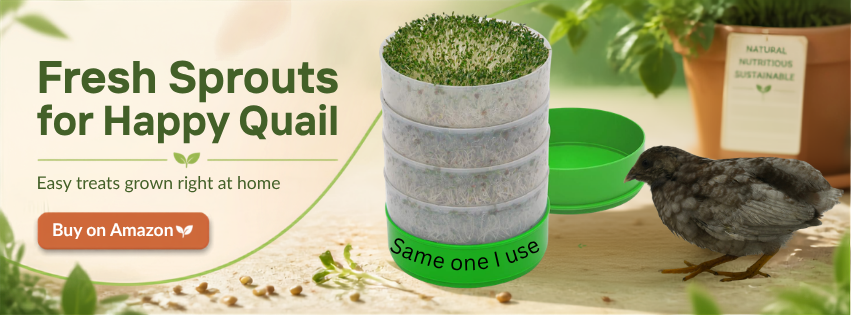
Sprouts are easy and this is the container I use to have fresh sprouts everyday
When too many mealworms become a problem
Last week, a customer told me that she had been feeding her button quail large quantities of mealworms. The hen later died from egg binding.
We cannot conclude from that information alone that mealworms caused the egg binding. Egg binding can have several causes. However, obesity is a recognized risk factor, and the situation illustrates how quickly a calorie-dense favorite can dominate the diet of such a small bird.
Mealworms are not poisonous, and offering an occasional mealworm is not the same as feeding large quantities every day. The problem is proportion.
For confined button quail, I prefer modest amounts of greens for enrichment. I have used alfalfa sprouts successfully. Even greens should supplement the appropriate complete feed rather than replace it.
A fat hen is not necessarily a healthy hen
Another customer contacted me because her hens had stopped producing eggs and were dying. She opened one of the dead hens and found so much yellow fat in the body cavity that she could barely see the organs.
That is not a healthy reserve for winter. It is a warning.
Overconditioned hens can experience reduced production and reproductive problems. Obesity is associated with egg binding, while diets dominated by treats, scraps, or scratch can predispose backyard poultry to fatty liver disease. Fatty liver hemorrhagic syndrome can cause the liver to rupture, leading to internal bleeding and sudden death. Merck Veterinary Manual
Penn State Extension also warns that table scraps and whole grains can make laying hens fat, decrease production, and contribute to prolapse. Penn State Extension
This does not mean every overweight bird will become egg-bound or develop fatty liver disease. It means excess weight and an unbalanced diet are risks we can often prevent.
Processing birds can teach you about the living flock
I processed 20 Bresse last Thursday. As we worked, we checked the body cavities for excessive fat and examined the livers for changes that could suggest fatty liver disease.
That information matters beyond the birds being harvested.
Poultry can conceal developing health problems. When you process a representative group, the amount of internal fat and the condition of the organs can reveal nutritional issues that may also be affecting the live birds.
If several harvested birds carry excessive abdominal fat, do not dismiss it as an individual oddity. Review what the entire flock is eating:
Is the complete feed appropriate for the birds’ age and purpose?
Are treats replacing too much feed?
Does every family member give the birds “just a little something”?
Are calorie-dense treats available every day?
Are confined birds receiving more food than their activity level requires?
What you find inside processed birds can help you make better decisions for the birds that remain.
A simple rule for poultry treats
The more confined the bird, the fewer treats it should receive.
A confined bird cannot compensate for the nutritional decisions you make. Complete feed should form the foundation of the diet, especially for laying hens and small enclosed birds such as button quail.
Free-ranging changes the variety available, but it does not make every pasture nutritionally complete. Continue offering an appropriate feed and observe what the birds actually consume.
Treats should be occasional and small enough that the birds still eat their balanced ration. For confined button quail, a little greenery or some alfalfa sprouts can provide enrichment without turning a calorie-dense favorite into a major part of the diet.
Feed for nutrition first. Treats come afterward.
Treats are not automatically harmful. The problem begins when they replace too much of the balanced feed you are paying for. The more confined your birds are, the more carefully you must control the extras. Feed the complete diet first, use treats sparingly, and let the condition and production of your flock tell you whether the balance is working.
The Homesteading Family Magazine has no ads! It’s helpful and I look forward to mine every month.
-
Yes, but they should be offered in very small amounts so they do not replace the complete feed. This is especially important for confined birds, which cannot forage elsewhere to balance what they eat. The more confined the bird, the fewer treats it should receive.
-
No. Mealworms are not inherently bad for chickens or quail when offered occasionally and in small amounts. The problem is quantity: mealworms are calorie-dense and can displace nutritionally complete feed. What looks like a small serving can be a large part of a button quail’s daily intake.
-
For confined button quail, I prefer modest amounts of fresh greens, such as alfalfa sprouts. They provide enrichment without adding the concentrated calories found in many popular treats. Offer them in small portions alongside—not instead of—an appropriate complete game-bird feed.
-
Yes. Too many treats can dilute the nutrients in a complete feed and add excess calories. An overweight hen may lay fewer eggs and is at greater risk for reproductive problems, including egg binding and prolapse. If production drops, look honestly at how much scratch, mealworms, scraps, and other extras the flock receives.
-
Excess internal fat is difficult to see in a living chicken. Warning signs may include excess body weight, reduced laying, difficulty laying, or sudden health problems, but these signs can have other causes. When processing birds, look for heavy deposits of yellow fat surrounding the organs and examine the liver for unusual enlargement, paleness, or excess fat. What you find in harvested birds can help reveal a feeding problem that may also affect the rest of the flock.