

Bird IDs, painter’s tape, and why cage space deserves a measuring tape
I wing-band my chickens, leg-band my turkeys, and identify my quail by cage. Those are three different approaches, but they serve the same purpose: keeping track of the birds in front of me. Once you have several breeding groups and different ages moving through the barn, “I’ll remember” starts carrying a lot of responsibility. I would rather give that job to a label.
Some of the most useful tools in my barn are very ordinary. I use write-on tags for quail cage IDs and painter’s tape to carry identification from the incubator to the brooder and onward. The tape is easy, cheap, and removable. A system does not have to be expensive to be useful, but it does have to keep the right information with the right birds.
Quick Look
- Match identification to its purpose. An individual bird ID and a breeding-group ID tell you different things.
- Carry the identification through every move. Eggs, hatching trays, and brooders need a clear connection to their source group.
- Measure pen space. Floor area divided by bird count describes space per bird; it does not, by itself, establish suitable housing.
- Record changes as well as results. Moving breeders or changing group size can affect how you interpret later records.
- Keep research in context. A stocking-density experiment is evidence about particular birds and conditions, not a universal capacity chart.
Identify the Bird—or Identify the Group
My chickens get wing bands, my turkeys get leg bands, and my quail cages get identification tags. I am not using the same tool for every species. The important question is what I need that identification to tell me. Am I following one bird, or am I following a group?
An individual ID lets a record stay connected to a particular bird when its location changes. A cage ID identifies the group housed there, provided the record stays current when birds move. Those are different levels of information. A cage label cannot tell you which individual hen laid an egg if several hens share that cage.
That distinction matters when we talk about breeding records. Knowing an egg came from a particular breeding pen can identify its source group, but it does not automatically establish its exact parents. If the pen contains multiple hens or males, the record needs to reflect that uncertainty. Good records are useful partly because they make clear what we know.
I have written before about leg bands and identifying chickens and quail. Identification is only the beginning, though. The number or label needs a record behind it, and that record needs to follow changes in the flock. Otherwise, we have marked birds without preserving much useful information about them.
My Quail Cage Tags Are Simple
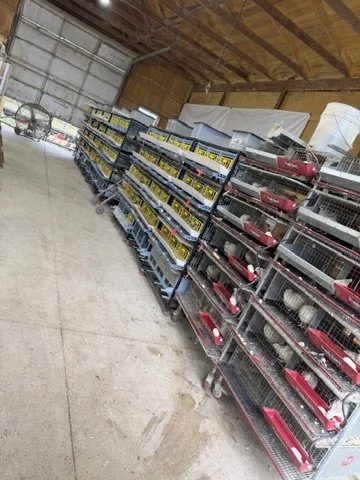
For my quail, I write the cage ID on a tag attached to the cage. These are the write-on plastic tags I use. They give me a place to put the identification where I can read it. That is the job I need them to do.
For anyone building a system, I would start with a short, clear ID that can be copied onto other labels and records. Color can help you find a group quickly, but a written ID gives you something specific to record. Whatever format you choose, use it consistently. “Blue cage” becomes less helpful if there are several blue tags and no other distinction.
It also helps to separate the location from the birds occupying it. A pen number can remain the same while its breeding group changes. Record the date of that change so an older hatch is not accidentally attributed to the current occupants. The label on the cage tells you what is there now; the dated record preserves what was there before.
Painter’s Tape Carries the Information Forward
Painter’s tape is part of how I keep that connection through a hatch. It is easy, cheap, and removable, and the identification can follow from the incubator to the brooder and on. I do not need a complicated label at every stage. I need to know which birds I am looking at.
The transfer is where the label earns its keep. Before eggs move into a hatching tray, check that the tray identification matches the source group. Before chicks move into a brooder, have their identification ready there, too. Labeling the destination before the move leaves less to reconstruct afterward.
A label preserves information, but it does not physically separate chicks. If several groups need to remain distinguishable, their hatching and brooding arrangement must preserve that separation as well. Putting different labels beside chicks that can mingle will not maintain their group identity. The identification system and the housing arrangement have to work together.
The same principle applies when groups are deliberately combined. Record which groups were combined and when, rather than leaving an old label that tells only part of the story. Sometimes combining birds is a sensible management decision. The record should describe that decision accurately.
Cage Space Is a Measurement, Not an Impression
A pen can look roomy when the birds are small. It can also look different depending on where they happen to be standing when you walk past. Neither impression gives you a measurement. Start with the dimensions and the number of birds actually housed there.
For a rectangular floor, multiply length by width using the same units. A floor measuring 24 by 36 inches has 864 square inches of area. With eight birds, that works out to 108 square inches per bird; with twelve, it is 72. Those figures illustrate the arithmetic, not a recommended stocking allowance.
Then look at what that measurement includes. Equipment that blocks access to part of the floor changes how the birds can use it. A floor-area calculation also says nothing about enclosure height or whether every bird can reach feed and water. Write down the dimensions, but inspect the arrangement, too.
What the Research Says About Crowding
A Japanese quail experiment used 216 birds beginning at 14 weeks of age under subtropical Egyptian conditions. It compared cage floor allowances of 200, 167, and 143 square centimeters per bird. The largest allowance produced better fertility, hatchability, and several egg-production measures, along with lower corticosterone than the denser treatments. This study provides evidence that crowding can affect outcomes beyond whether birds physically fit inside a cage. Read the original study abstract.
That experiment did not establish an ideal allowance for every backyard quail setup. The largest space tested was simply the best-performing treatment among those particular comparisons. It would be a mistake to turn it into a universal recommendation for different strains, ages, climates, or housing designs. I reviewed the available abstract, so conclusions here stay within what it reports.
Research with broiler chickens adds another useful qualification. A study comparing conventional and slow-growing broilers at two stocking densities found substantial behavioral differences associated with strain and age, while density affected relatively few of the measured behaviors. Slow-growing birds generally stood and walked more, and birds at the lower density preened more. These findings show why bird type and age belong alongside a space measurement when interpreting behavior. Read the original research paper.
Neither paper supplies a capacity number for my turkey pens or every chicken breeding pen. The practical lesson is to measure first, consider the birds and housing, and keep observing as the group changes. A count that worked for younger birds deserves another look as they grow. An organized record should make those changes visible.
Record Enough to Explain the Results
A useful record needs enough context to answer the questions you are likely to ask later. For a breeding group, that might include its ID, the birds assigned to it, and the dates birds were added or removed. For a hatch, it might include the source group, setting date, eggs set, and chicks hatched. These are examples of a workable record, rather than a claim that everyone needs the same form.
Be precise about what your numbers mean. “Chicks hatched divided by eggs set” measures hatchability of eggs set, while “chicks hatched divided by fertile eggs” uses a different denominator. A low hatch from eggs set does not tell you, by itself, whether the main loss involved infertility or embryo mortality. Keeping the underlying counts gives you more information than a percentage alone.
Dates matter because management changes can overlap with the results you are trying to understand. If you change breeders, group size, or housing, record when it happened. That does not prove the change caused the next result. It gives you a sounder starting point for deciding what deserves a closer look.
Make the System Easy to Keep Using
I like painter’s tape because it is easy, cheap, and removable. That matters in a working barn, where the system has to be usable during the chores. A label that takes too much trouble to replace can easily become an outdated label. Simple tools can support good records when they are used consistently.
My approach begins with the birds: wing bands for chickens, leg bands for turkeys, and cage identification for quail. The next step is keeping that identification connected as eggs hatch and birds move. Measured space and dated records add context to what I see in the pens. Together, those details give me something more dependable than trying to remember it all.
Frequently Asked Questions
Does every bird need an individual identification number?
It depends on what you need to track. Individual identification is useful when records must follow a particular bird through moves or breeding decisions. Group identification can preserve information about a breeding pen or hatch group, but it does not establish each bird’s individual history. Choose the level of identification that answers your actual management questions.
Can a quail cage ID tell me a chick’s exact parents?
A cage ID identifies the recorded source group. If that group contains several hens or males, the label alone cannot establish the chick’s exact dam or sire. Record the source as a breeding group unless you have additional evidence of individual parentage. Keeping that distinction clear prevents a group record from becoming an unsupported pedigree.
What information should go on a hatching-tray label?
Include a clear source-group ID and enough date information to distinguish that hatch from another. Keep the same identification format in the hatch record and on the receiving brooder. If several groups must remain separate, use a housing arrangement that preserves their separation. A readable label cannot recover identity after indistinguishable chicks mingle.
How do I calculate space per bird?
Measure the floor area the birds can access, using consistent units, and divide it by the number of birds. For a rectangular floor, calculate length multiplied by width before dividing. Record the enclosure height and equipment arrangement separately because those details are not captured by floor area per bird. Use the calculation to describe the setup, then assess its suitability for the species, age, size, and management conditions.
Is the roomiest treatment in a study the recommended stocking allowance?
The roomiest treatment tells you what researchers tested, not necessarily the best possible housing allowance. A study may compare only a narrow range of densities under one set of conditions. Results also need to be interpreted alongside the birds’ species, age, strain, and housing. Use the findings to inform decisions without treating an experimental treatment as a universal standard.
Research Sources
El-Tarabany, M. S. (2016; published online 2015). Impact of cage stocking density on egg laying characteristics and related stress and immunity parameters of Japanese quails in subtropics. Journal of Animal Physiology and Animal Nutrition, 100(5), 893–901. doi:10.1111/jpn.12404.
Whittle, R. H., Karcher, D. M., Erasmus, M. A., & Weimer, S. L. (2025; published online 2024). Effects of genetic strain, stocking density, and age on broiler behavior. Poultry Science, 104(2), 104723. doi:10.1016/j.psj.2024.104723.
As an Amazon Associate, I earn from qualifying purchases.